
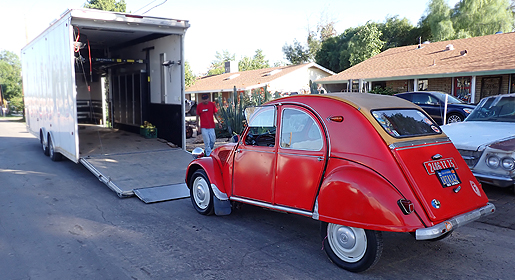
Bo Malefors is a Swede who moved to Arizona 40 years ago. While in Sweden he learned that a fair number of the 2CVs sold there were early Belgium built models and most of them were grey.
He has kept is interest in Belgium built 2CVs alive and presently owns 3, though all of his were originally red leaving the factory.
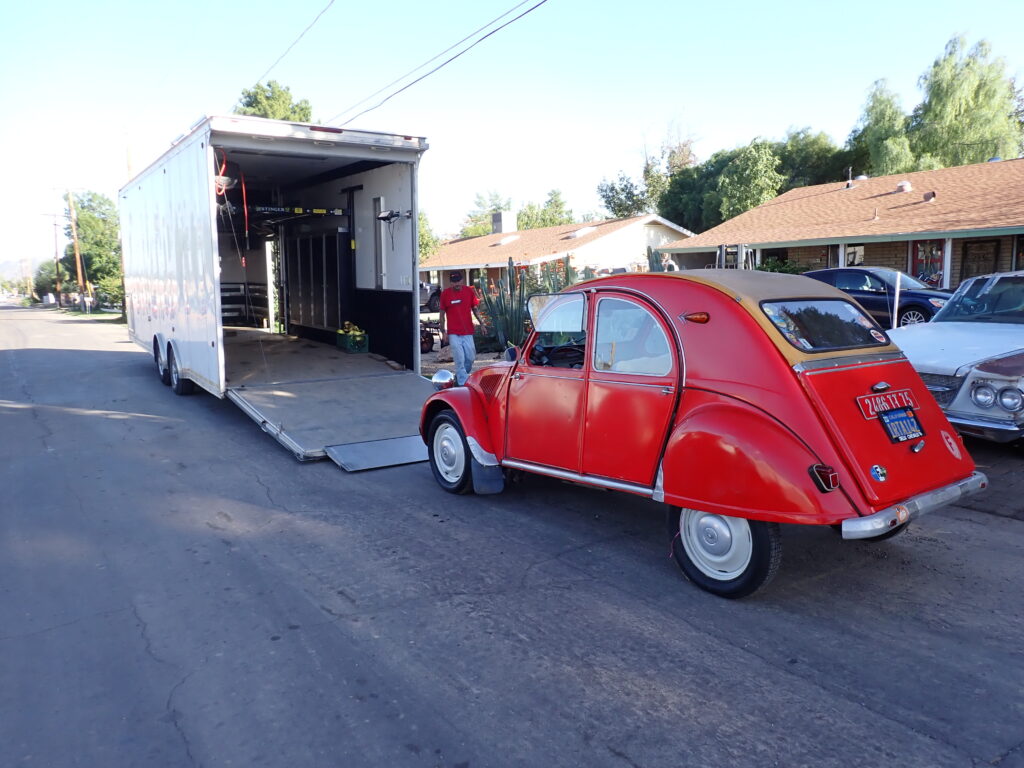
Bo and his wife Sarah traveled last month from Phoenix, Arizona to San Francisco and picked up a 1957 (1956 really) Belgian 2CV that he has been working on buying for a long time.
It is a 1956, but called a 1957 on the title, Belgium built 2CV, imported by Citroën Car Corp in Beverly Hills when new. It is unknown who bought it new and kept it until 1960, but ownership from 1960 until now is known.
The 2CV traveled up the coast in 1960 to Paso Robles and stayed there for decades until it moved to San Francisco almost 40 years ago. Bo is the fourth owner since new and the car has left California for the first time and it now lives in Arizona.

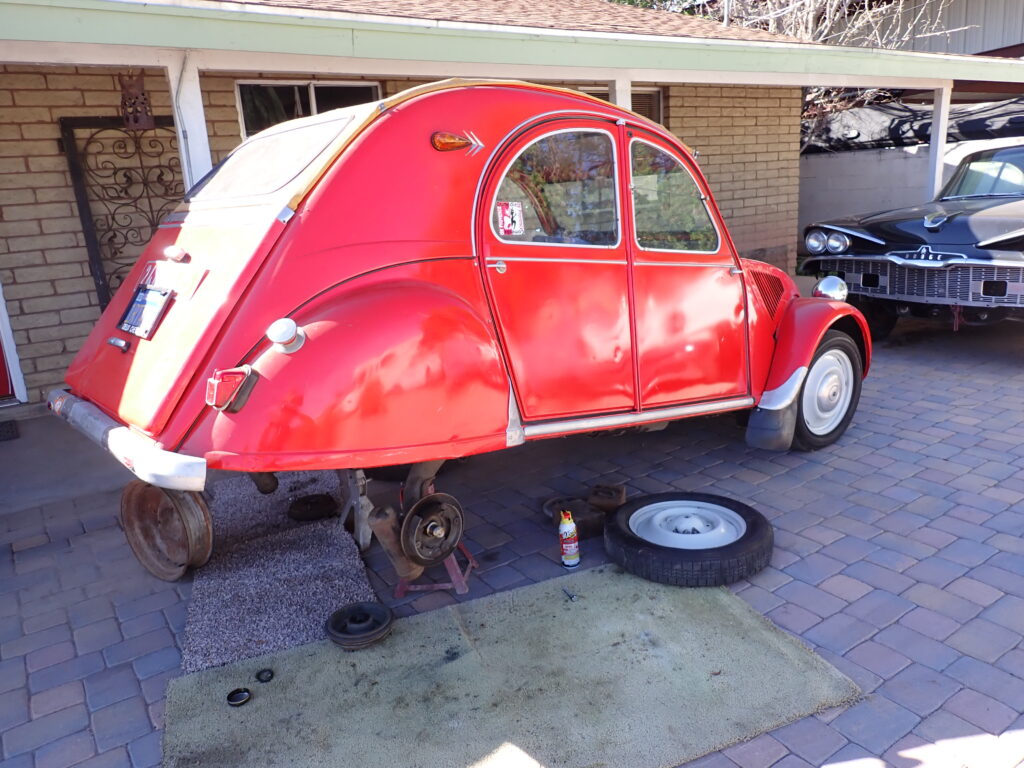
As it spent 10 years in a garage, Bo is going through the brakes and cleaning the fuel tank. Once that is done he is hoping that by replacing the battery and fitting some fresh tires, it will be running and driving again.
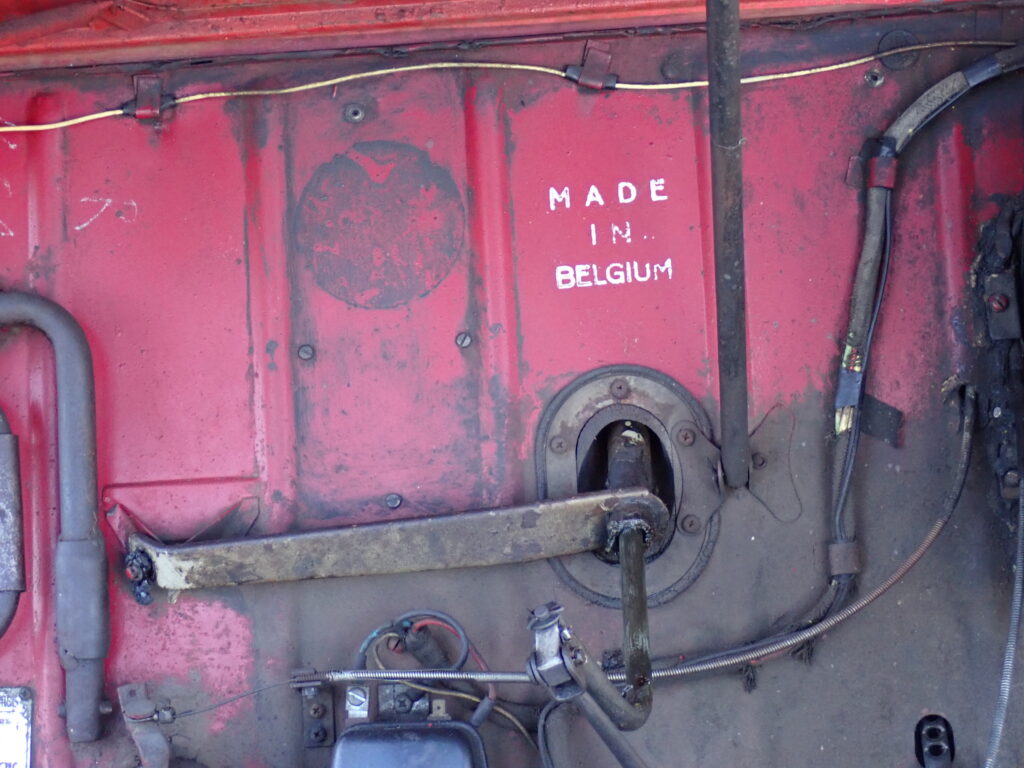
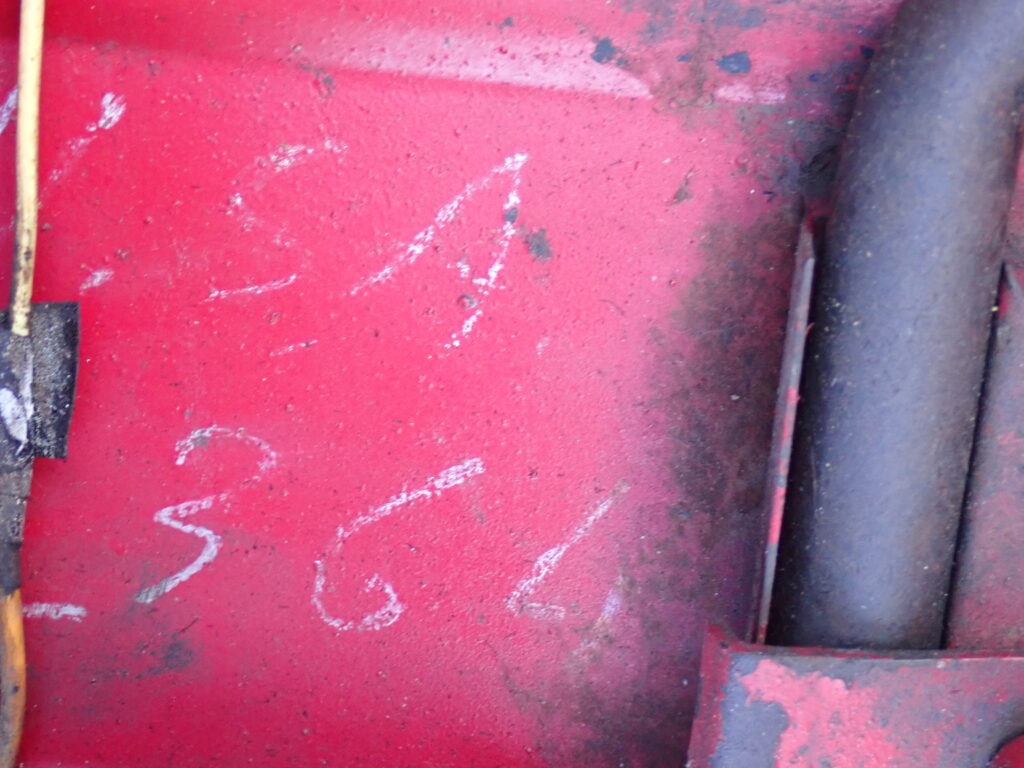
Bo comments:
“I would call it good driver condition but that works for me since we are planning on driving it and using it. I will have to redo the seats but again, no real hurry with that job. have no big plans for the 2CV but over time I am planning on putting it back to how it looked in 1956, (1957) when sold new. The correct turn signals, the correct roof, bumpers etc. It is a little interesting to me that the 2CV I just got has French a lic plate on the decklid and an “F” sticker on the decklid even though the closest to France it has ever been was when it was built, in Belgium.”
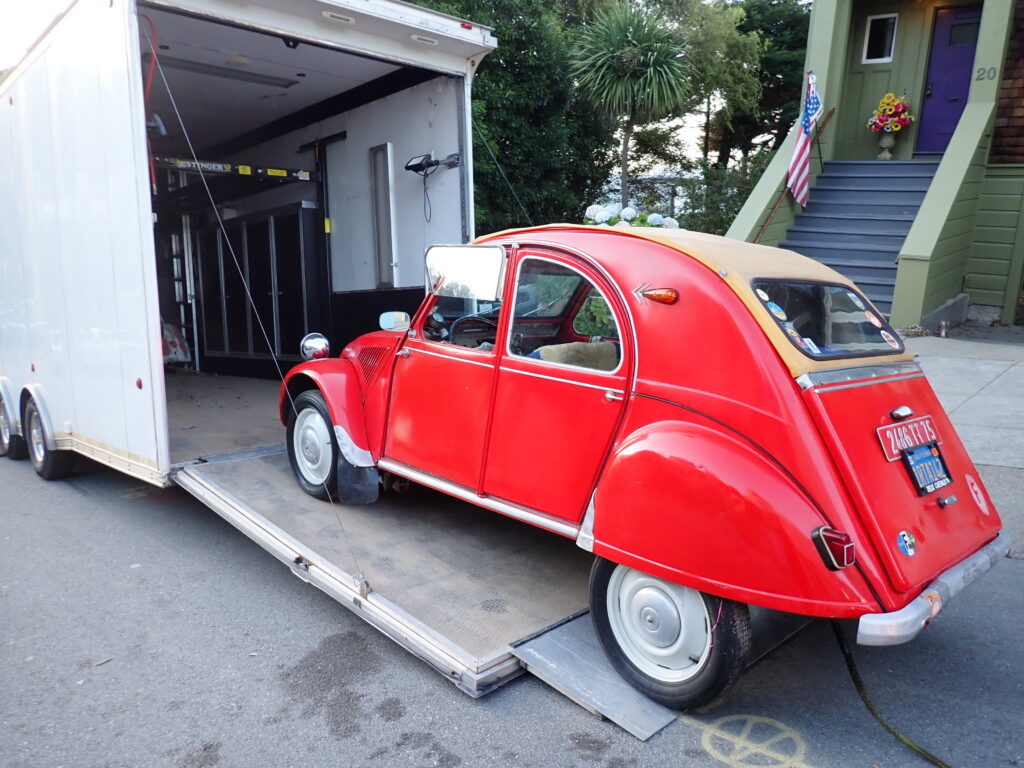
It is not supposed to have any turn signals at all high up on the C-pillar. The hole where European cars had the turn signals on the C-pillars should be “covered” by the sideways mounted chevrons, still there. But somebody added the turn signals next to the chevrons.
This car has the wrong, shorter “French” roof and it has a stainless steel band to cover the gap between the trunk lid and the roof. I know a person in the UK who makes the correct roofs for the Belgium built cars so at some point I will order a new and correct roof for this car.
Early Belgium built 2CVs can be distinguished by their metal trunk lid, before the French cars got them in 1958. It’s not the same trunk lid as the French cars received. It is shorter making it necessary to use a longer roof.
Another detail specific for Belgium built cars is that the rear window is not rectangular like on French built cars. After they got a metal trunk lid, the Belgium built cars had their own trapezoid shape rear window.
This 2CV has been fitted at some point with a more robust front bumper. The original front and rear bumpers and hubcaps were made from thin aluminum on Belgium built cars, The bumpers can be easily deformed and/or broken. This one still has the rear bumper but as you can see it has a pretty awful looking front bumper. Bo did get the original front bumper and it will be reinstalled at some point, but presently the original bumpers are in relatively bad shape.
Belgium built 2CVs have rear tail lights mounted on each rear fender that look like they are from the Traction Avant but mounted laterally.
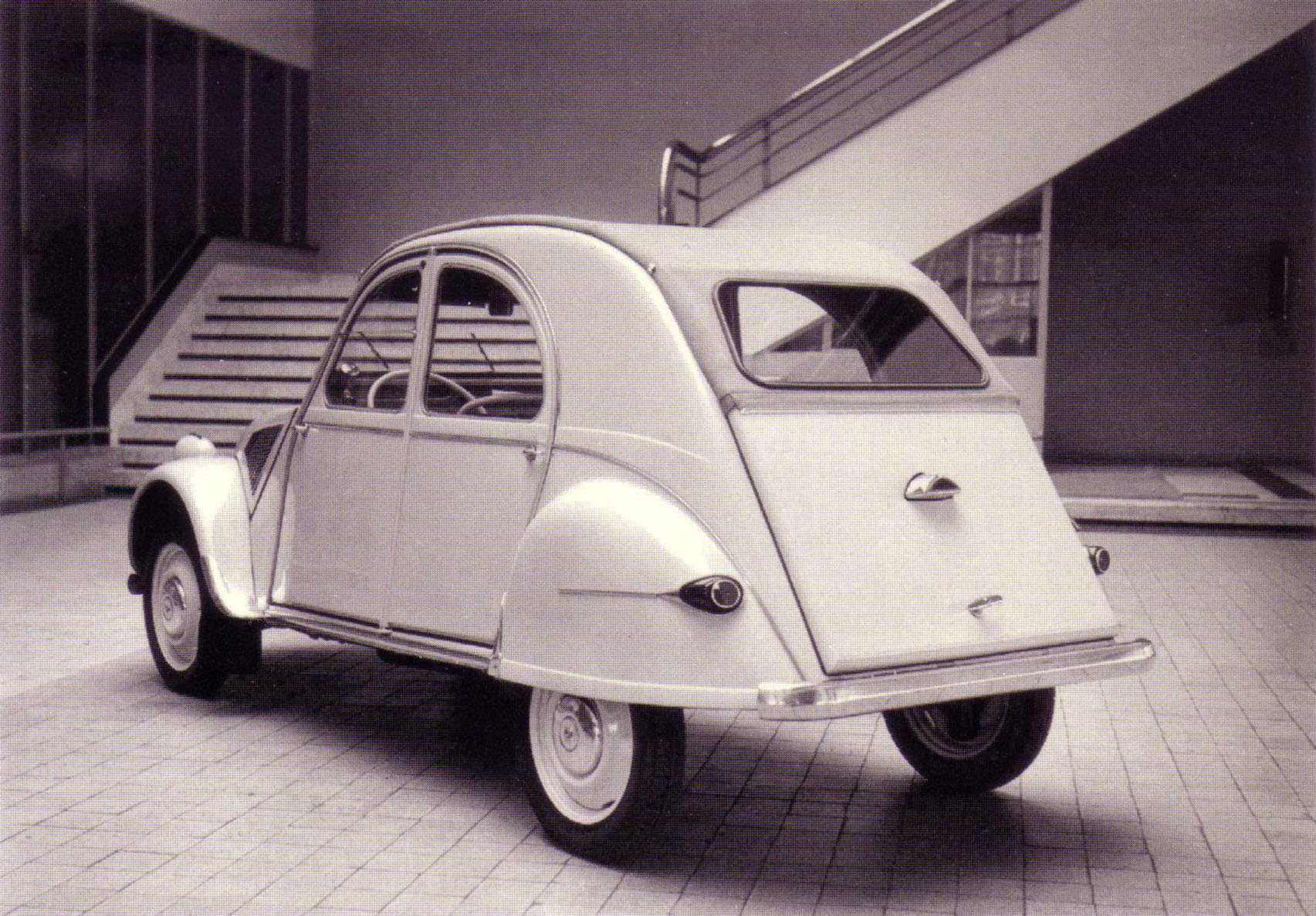
Bo says:
There has been a lot of discussion about if the tail lights were just pulled from Traction Avant parts bin or if they were specific for the Belgium 2CV cars. I have it on very good authority that they are not the same as lights used on Traction Avants.
My friend in Sweden, who is a 2CV restorer told me that only the “luxury” version of the Belgium built 2CV cars, called AZL had the fancy sideways installed taillights that look like Traction Avant taillights. They were mounted on cast aluminum bases. And again, only for Europe and not used for the US cars.
I’m enclosing a picture or two to show what the US cars looked like when they were ready to sell. The “patina car” is my 1956 2CV that has been off the road since around 1961 and it is totally original and untouched since it left Citroen Cars Corp in So Cal in 1956 (or possible in 1957). It has never had taillights on the rear fenders and the same goes for the solid red 2CV.
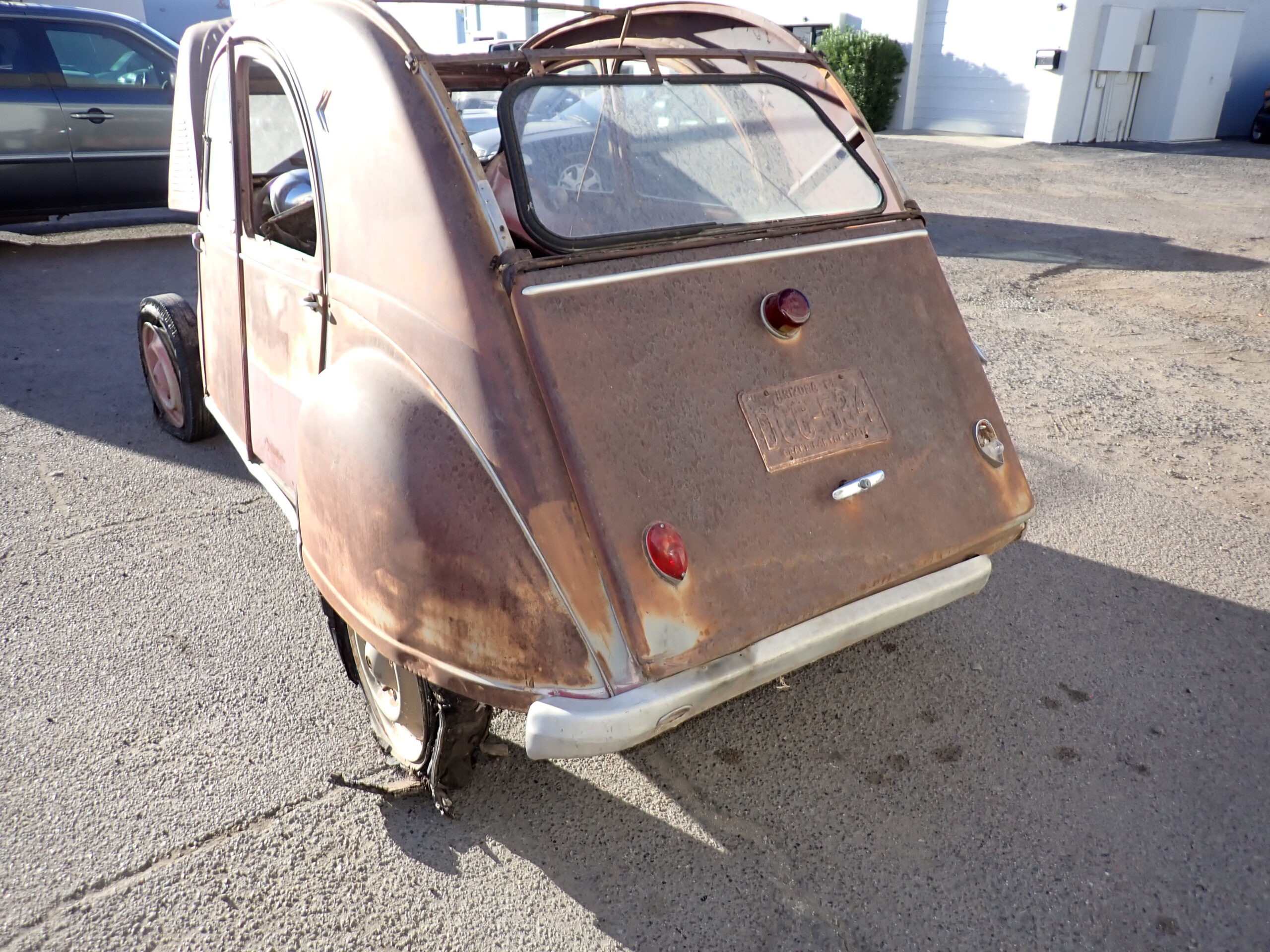

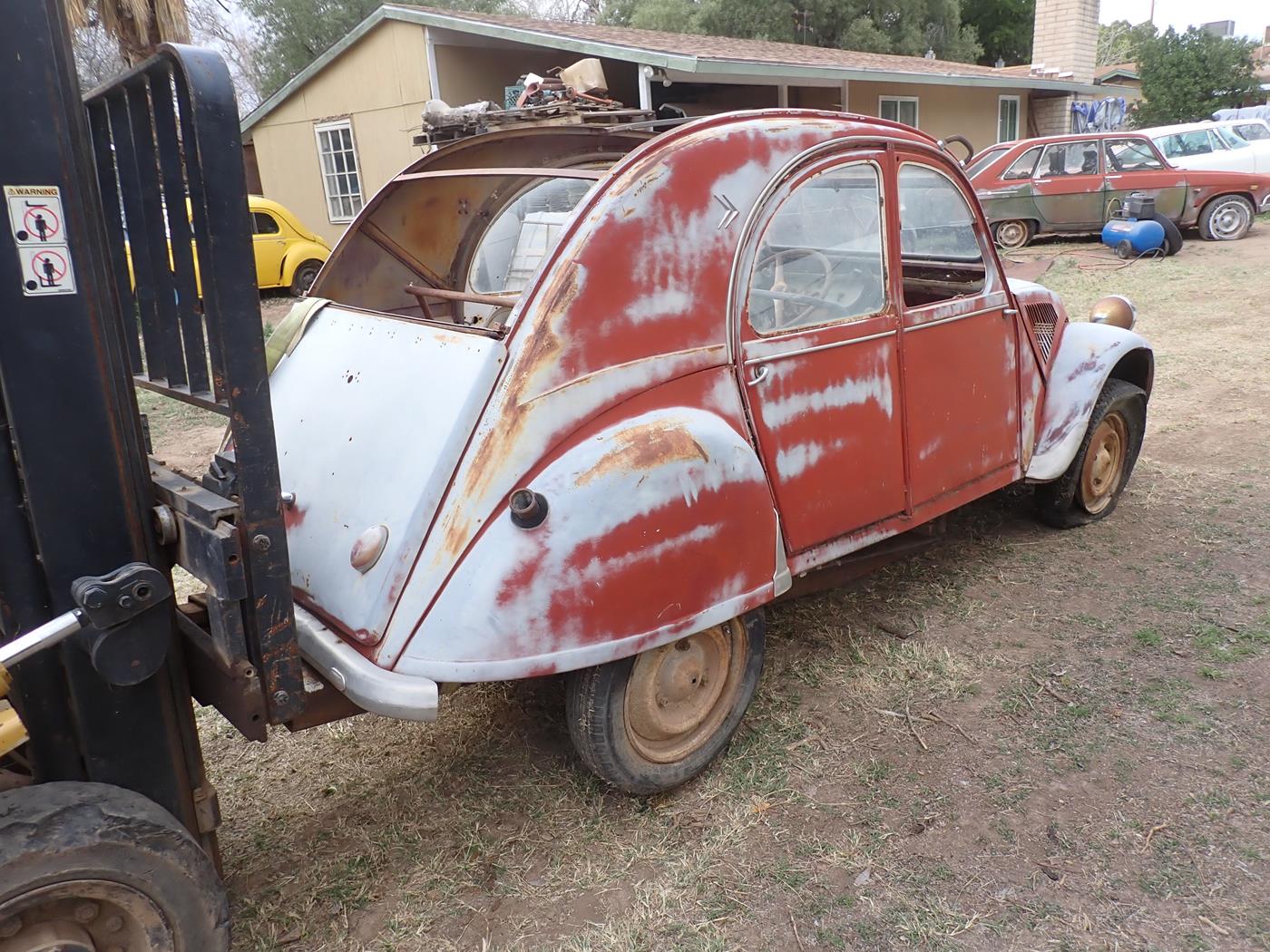
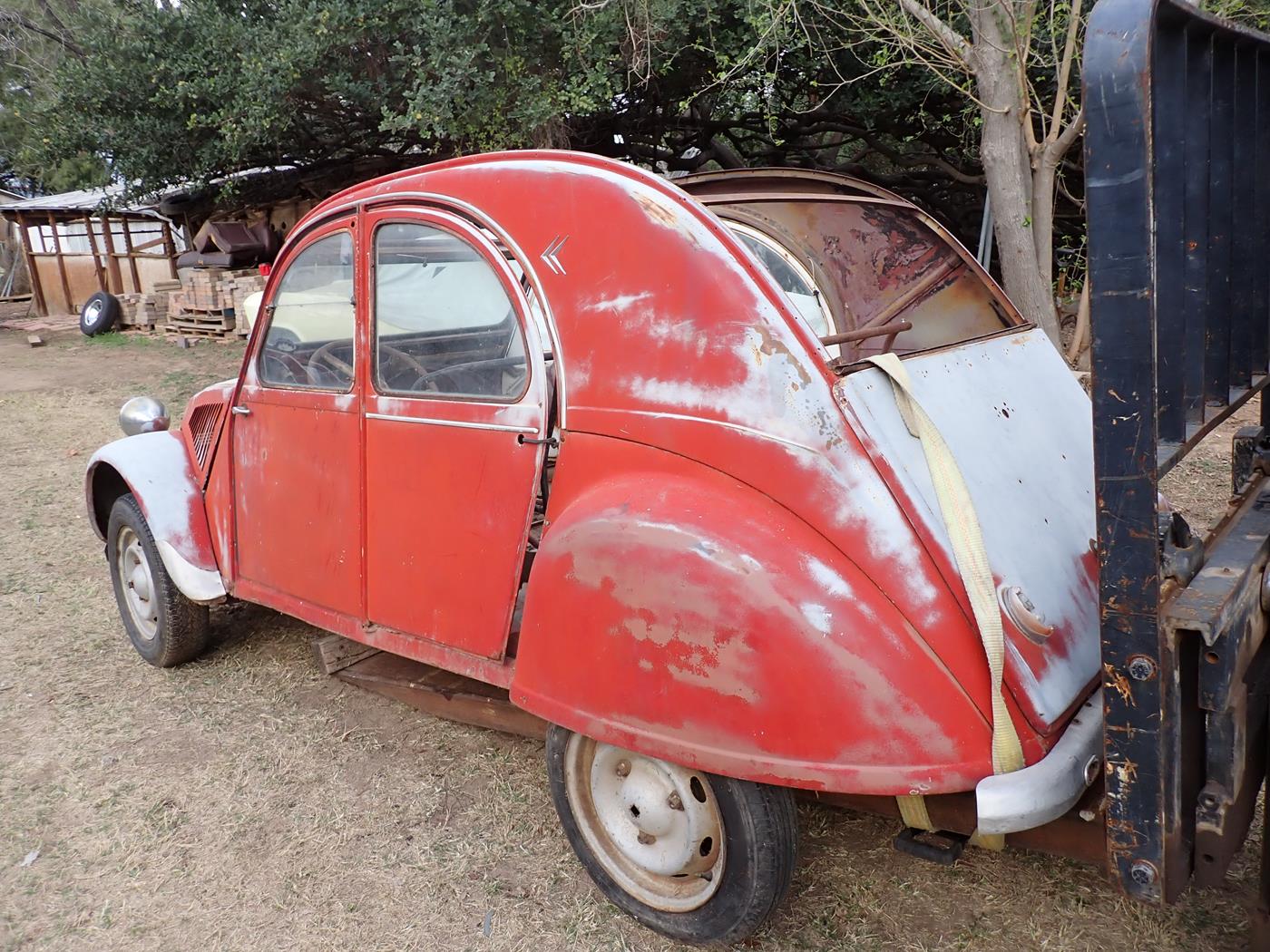
The car is supposed to have one single taillight, mounted high up on the decklid, not the two fender mounted taillights and it is supposed to have front and rear mounted “teardrop blinkers”, used only or at least mostly on west coast imports. (Several of my Renault 4CV cars use the same turn signals while other 4CV I have owned that I think came in either through a Texas port or possible east cost port use different blinkers).
Strangely enough they used only the center taillight, the outer lights are blinkers only, no wiring for them to come on with running lights. Odd but that is the way they were sold.
Citroën Cars Corp imported around 1000 2CVs during a 10 year period starting in late 1955. But only the few of 1955, 1956 and early 1957 cars that came in were Belgium-built. Bo speculates that is was probably fewer than 100 all in all. After that they were brought in from France.
Bo recounts how he acquired his first 2CVs in Arizona:
I got my first 1956 2CV, the one that is still sitting here awaiting restoration by chance. At the time I owned a restoration shop, specializing in 1957-62 Dodge, Chrysler and DeSoto cars even though personally I always loved older French cars and we worked on hundreds of different cars over the years. I was often offered cars for sale and at one point I had bought a little British pickup truck, Austin I think. I don’t have a lot of interest in British cars in general, with few exceptions and I put it up for sale.
A couple came and looked at the pickup and the lady said, “that was my first car”. I said, you had one like it when you were young? She replied, no I owned that specific truck when I was young. She asked if I was interested in trading for something else and I said not really. She said they had a 2CV car to trade with. I went and looked at it and liked what I saw, so we traded cars.
That was probably 20 plus years ago. I still have the 2CV, still unrestored and they still have the pickup truck, still not restored. They do have a large collection of unusual mostly small cars; Subaru, DAF, some small, mid 30’s British convertibles, a 3 wheeled Morgan from the 30’s or 40’s etc.
Many years later, at least 10 years later I saw another 2CV advertised here in Phoenix for sale. I went and looked and it was another 1956 Belgium built 2CV car, in original but used condition. I bought it and it is now going through a complete restoration in Sweden. I don’t know the correct mileage as the Arizona sun has bleached the numbers on the odometer but I assume that since it was on the road for only around 5 years the original miles are very low. Opening the engine a few years ago did confirm that notion, as the engine looked like new inside. It got new bearings, piston rings etc, but it did not need anything to speak of and that engine runs like a champ again.
I also owned a few Traction Avants until recently, Peugeot 403’s, Renault 4CV cars and even a bunch of Renault R16 but most of them are gone now, as I am getting on in years I have thinned out the number of cars I am keeping and I only have the three 2CV cars, two Renault 4CV Decapotable’s, one being restored right now, and a few late 50’s Dodge and DeSoto cars left.
You can read more about Bo’s other two 2CVs (one that was last driven in 1961 and is still untouched since new) at: https://citroenvie.com/two-early-usa-spec-2cv-survivors/.
There are many differences between the early European sold Belgium cars and the US version and it is fun to discover the differences as we find more and more of them.