
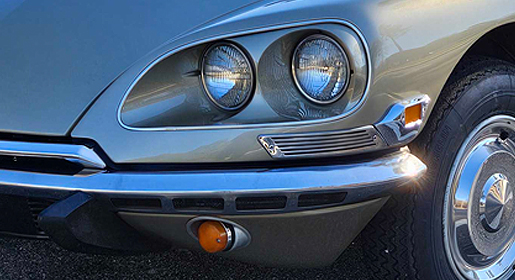
By Chris Dubuque….
As soon as cars started becoming commonplace in the early 1900’s, it was recognized that insufficient lighting and/or glare for oncoming drivers was a safety issue. Glare seemed to be of particular concern. Looking through media archives reveals scores of newspaper articles across the US and Canada in the very early days of the automobile that warn of the dangers of headlight glare. A typical example is the July 1914 edition of the Dayton Daily News, where they wrote:
“…That headlight glare is a source of danger on the highway is unquestionable; that it is something that should be eliminated or controlled is a natural conclusion…”
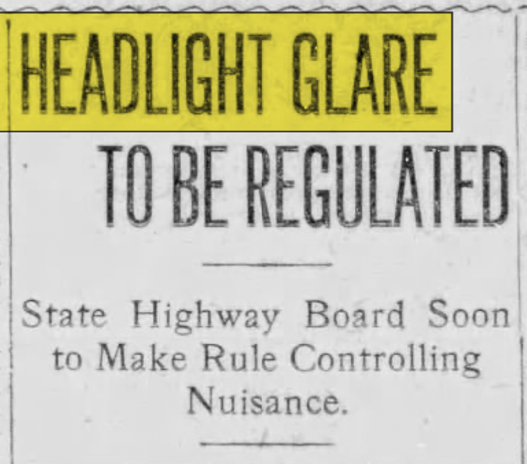
Since there were no federal standards for cars in this era, individual states started developing headlight laws to address the illumination and glare issues. It is said that Massachusetts was one of the first states to implement a headlight law, as can be seen by this newspaper headline from August, 1915.
With a little digging, I found some text of the 1915 Massachusetts law:
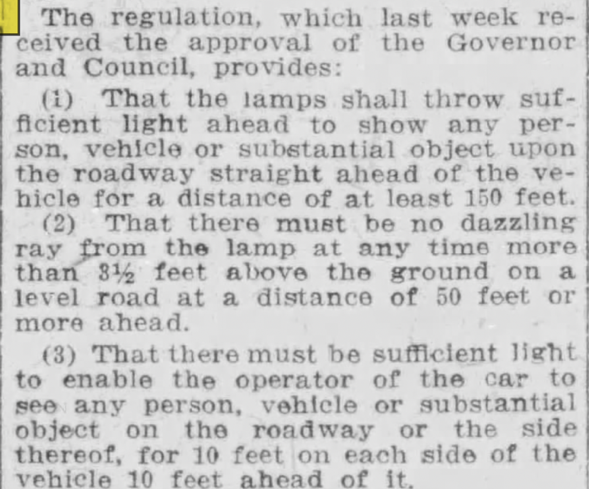
While Massachusetts is often credited for implementing a headlight law early, I found that by the end of 1915, several other states had created their own headlight anti-glare laws. It was not long before there was a myriad of different rules in different states concerning headlights that were not standardized and sometimes conflicted with each other.
In Canada, the story was similar. The province of Ontario released a Motor Vehicles Act in 1903. This law, one of the first in Canada, was updated in the 1920’s to address the problem of headlight glare, sometimes referred to in Canada as anti-dazzle laws. But these specific rules only applied to Ontario. Other provinces started developing their own laws.
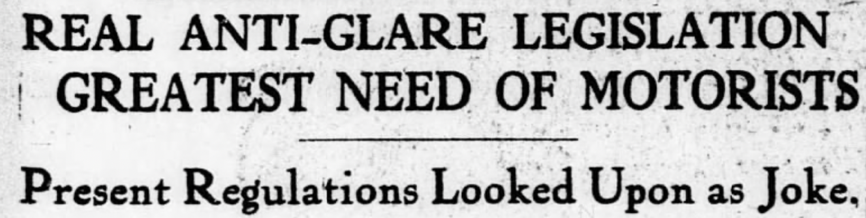
The variability of rules across the states and provinces was definitely a dilemma for car manufacturers who were trying to sell cars in a standardized configuration. Also, a dilemma for car owners who were apparently being cited for violations, simply by driving across a state or provincial border. Newspaper articles discussing the conflicting laws were common. Two example headlines follow – one from 1920 and one from 1923:

The different laws also made part interchangeability a problem since some hardware was uniquely developed to comply with a particular state’s laws.
STANDARDIZATION EFFORTS
While researching this issue, I discovered that there were several early attempts at standardizing headlight designs and lighting performance in the US and Canada. These included efforts by the Society of Automotive Engineers (SAE) and an organization called the National Safety Council (NSC). These (and other) groups started focusing on headlight design by about 1915, but it wasn’t until the 1930’s that any of these standardization efforts had broad, nationwide success.
In 1933, a group was formed that was called the American Association of Motor Vehicle Administrators (AAMVA). This organization was dedicated to nation-wide standardization of auto-related issues, such as licensing and traffic laws. An example of a successful effort by this group was the standardization of the size of license plates across all of the US and Canada in 1956.
As one of their standardization efforts, the AAMVA took on vehicle headlights. They orchestrated periodic meetings with regulators from each state, automotive lighting companies, auto manufacturers, safety organizations, and the SAE to facilitate the development of an effective and safe headlight that could be approved for use across the country. Automotive regulators from Canada participated in these meetings as well.
Today, the AAMVA still exists and is still involved in harmonization of auto-related topics.
THE SOLUTION
In 1939, the AAMVA voted to adopt a 7-inch (178 mm) diameter sealed-beam headlight as the standard headlamp for all of the USA. As we all know, a sealed-beam headlight is a self-contained, non-serviceable unit, where the lens, reflector, and filament(s) are hermetically sealed together in a single, glass housing under a vacuum. The lamp was specifically designed to minimize glare for oncoming drivers.
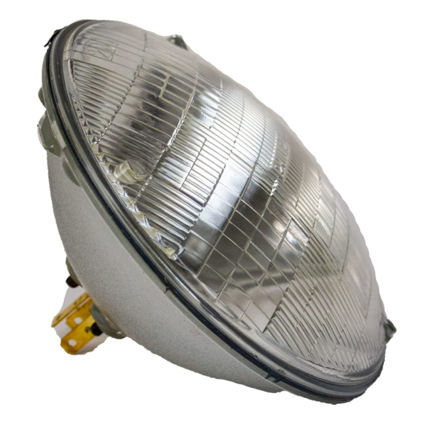
It is often written that it was in the General Electric (GE) labs where the sealed-beam headlight was born. To be fair, research shows that other lighting manufacturers played a role in the development of the sealed-beam, but GE is typically credited for the invention.
I was not able to find any specific laws that immediately resulted from this decision. Instead, the new 7-inch sealed-beams were adopted through a murky industry-wide consensus of affected parties. Some states eventually formalized the use of sealed-beams into law, but this took several years. Whether through consensus or law, 1940 was the first model year where it is reported that all new cars sold in America had the new 7-inch sealed-beam headlights.
The story in Canada was a bit different. Canadian provincial officials were also focused on the problem of headlight glare, so they were paying attention to the AAMVA’s efforts in the late 1930’s. I found several reports that Canadians were directly involved in the AAMVA meetings on headlights.
Although Canadian regulators were attentive to developments in the US, the early proliferation of sealed-beam headlights in Canada was driven mainly by the cross-border nature of the North American auto industry. Because American manufacturers sold largely identical vehicles in both markets, sealed-beam headlights appeared on Canadian cars concurrently with their U.S. adoption in 1940. So as in the US, there were no Canadian laws mandating their use.
EVOLUTION OF THE SEALED-BEAM
In 1955, there were minor improvements made to the 7-inch sealed-beam. One such improvement increased the wattage of the low beam by 15% and the high beam by 25%. A second improvement added bulb shielding and improved glass patterns to further reducing glare for oncoming drivers. Other than a few minor improvements, the AAMVA decision from 1939 froze headlight design in the USA for the next 18 years.
Finally in 1957, the AAMVA facilitated the approval of four 5 ¾-inch (146 mm) sealed-beams in addition to the dual 7-inch headlamps. These smaller lamps could be installed either horizontally, vertically, or diagonally. The new quad-lights had one lamp that had a dual filament for a LOW/HIGH beam and the second lamp was HIGH beam only.
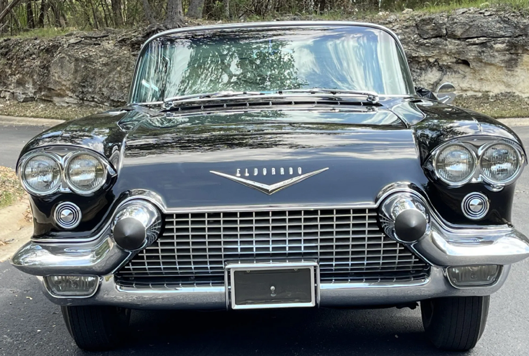
I read that a handful of states were slow to approve the quad light design so there was one model year (1957) where quad headlights were not allowed in those few holdout states, thereby forcing auto manufacturers to have two front ends available. By the 1958 model year, it seems that the quad lights were allowed across the US.
FEDERAL CONTROL
The year 1968 marked a distinct shift in how automotive laws in the US were administered. Before 1968, automotive laws were a smorgasbord of state laws and industry norms, complicated by the politics of various companies and organizations, each of which had their own agenda.
In 1968, the US federal government released sweeping changes in automotive rules when they released a series of new nationwide laws called the Federal Motor Vehicle Safety Standards (FMVSS). The specific standard that governed headlight design and performance was FMVSS #108 and it initially mimicked what had become the norm leading up to 1968. This perpetuated the use of the increasingly derided sealed-beam headlamp. It is noted that by the time the FVMSS’s were released, the European lighting manufacturers were well versed in the design of superb lighting from companies such as Cibie, SEV Marchal, Bosch, Hella, Lucas, etc.
Canada followed in 1971 with the release of the Canada Motor Vehicle Safety Standards (CMVSS), which were similar – but not identical – to the FMVSS’s. CMVSS #108 did not mandate sealed-beam headlights.
In 1974, with US and Canadian automotive laws now under the federal control, the use of four rectangular sealed-beams was added to the list of approved headlights. Since then, FMVSS #108 and CMVSS #108 have been revised several more times and now allow a much wider variety of headlamp designs.
SEALED-BEAM HEADLIGHTS AND NORTH AMERICAN CITROËNS
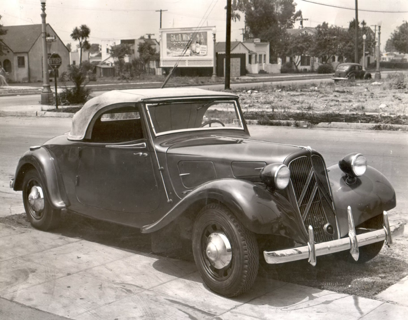
The first Citroëns sold in the USA were Traction Avants that were imported by Challenger Motors in Los Angeles, starting in 1938. Even though 1938 predated the sealed-beam implementation in the USA by a year or two, Challenger Motors appears to have been installing domestically-sourced headlight buckets with 7-inch sealed-beams on some (or perhaps all?) of the cars that they sold.
This is evident from period photos of Challenger Motor’s cars. An example is the cabriolet in this promotional photo taken in front of Challenger Motor’s location at Melrose and Sweetzer Avenues in Los Angeles.
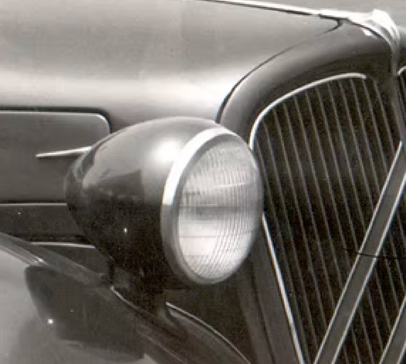
The very first DS’s and 2CV’s officially sold in the USA in the mid-1950’s were also equipped with 7-inch sealed-beams, as required by the 1939 AAMVA decision.
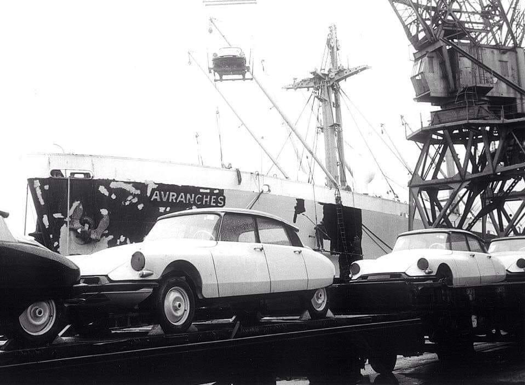
For the DS, this meant special headlight buckets that were made by Cibie and designed to accommodate the 7-inch sealed-beam’s unique asymmetric 3-tab mounting feature. The cars left France with these special buckets, but without any lamps installed. The sealed-beam lamps were then purchased domestically and installed after the cars arrived in the USA (see the following 1958 photo which shows new DS’s heading to the USA without headlamps installed). Sealed beams continued to be used on all US DS’s until Citroën stopped importing them in 1972.
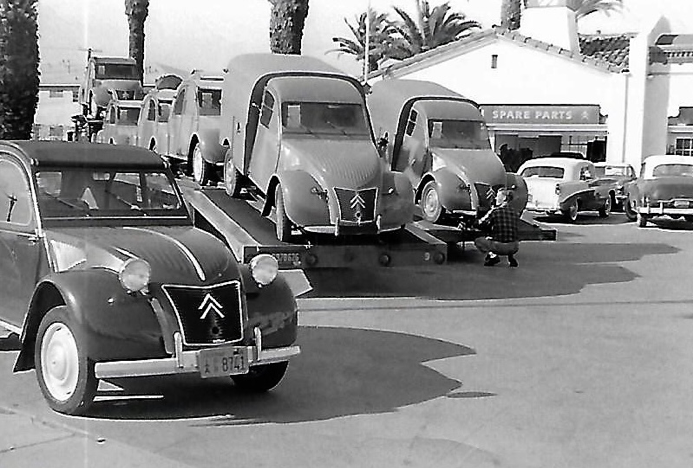
For the 2CV, Citroën USA sourced domestically available headlight buckets (made by a variety of manufacturers) that were equipped with the 7-inch sealed-beams. The following 1956 photo shows new 2CV’s arriving in Los Angeles waiting to have the new headlights installed. The 2CV sedan on the left has already been equipped with the sealed-beam lamps.
For Canada, the story was a bit more complicated:
- The earliest DS’s sold in Canada had full USA-style exterior lighting, which included sealed-beam headlights and Lucas stop/brake/turn lamps. The use of US-style lighting in Canada was driven by convenience for Citroën, not by law.
- By 1968, the winds had shifted and Citroën decided to equip DS’s in Canada with full European lighting.
- In the middle of 1971, DS’s in Canada again received the USA lighting with sealed-beam headlights. This appears to have been a Citroën decision intended to standardize configurations with the USA, not a change driven by Canadian law.
Canadian SM’s retained their Euro lighting until about 1973, at which time they received US lighting and sealed-beams. Again, a change that seems to have been driven by Citroën, not Canadian law.
A FEW MISTAKES?
The discussion above means that all DS’s and 2CV’s in the USA were equipped with sealed-beam headlights, right? Technically, yes – but there are a few unexplained anomalies….
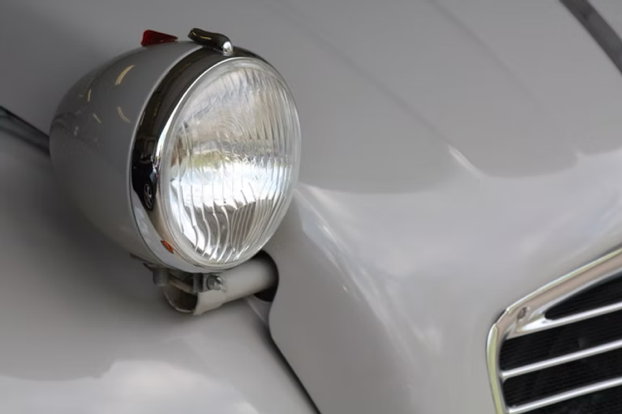
I found that a handful of 2CV’s were delivered in the USA with the Euro headlamps still installed. An example is the 1965 2CV AZAM in the following photo, but I found a few other examples that also retained their Euro headlights.
Second, a few DS’s in the 1971/1972 time-frame were delivered with Cibie H1 quartz iodine lamps in the inboard (high beam) position. An example is this 1971 DS that was originally sold by Kolar’s in Seattle, now owned by Greg Long.
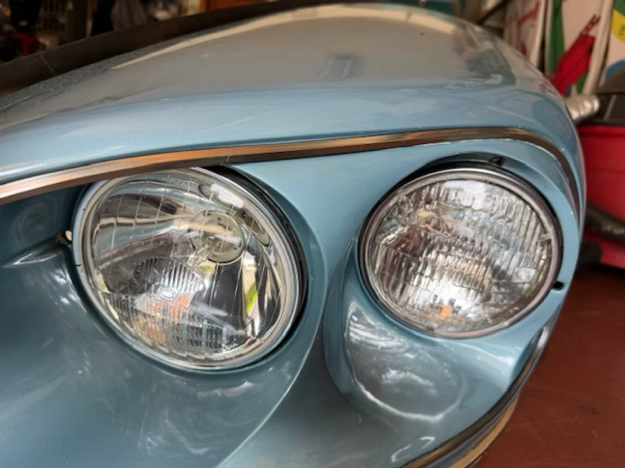
I am aware of a number of DS’s that were similarly equipped. Initially, I figured that the Cibie’s must have been retrofitted after delivery. However, a curious clue emerged on the car in the above photo when build stickers were discovered on the back side of the headlight bucket. These build stickers indicate that the car left France with the Cibie lights installed. Note that the factory build sticker has the “AVEC OPTIQUE” box checked. This is very unusual since most DS’s left France with no lamps installed and the “SANS OPTIQUE” box checked.
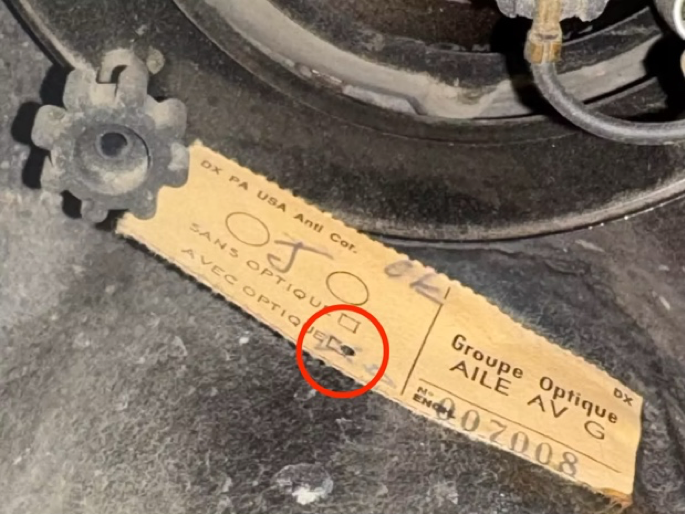
A possible explanation for these DS’s is that the affected cars were planned for a European delivery. In such cases, the American headlight buckets would have been installed during the car’s initial build. Since sealed-beam lamps were presumably not easy to find in France, the factory may have chosen to install Cibie lights for driving while the car was in Europe. When the car arrived in the USA, Citroën employees may have neglected to swap them out with sealed-beams. A theory anyway.
Both of these examples are in violation of the rules of the era (AAMVA or FMVSS #108). These lights simply should not have been allowed. Clearly a few cars slipped through here-and-there with the incorrect headlights.
CONCLUSION
There is no doubt that the sealed-beam headlights were instrumental minimizing the safety problems that were clearly perceived as a big issue before they were introduced in 1940. They provided an effective solution to the glare and illumination problems plaguing early headlight designs. They also provided a standard part that would fit any car across the country, at a low price.
Having said that, it seems to me that the laws mandating the use of sealed-beams lingered on way too long and did not allow for new technologies or designs that offered further safety and lighting improvements. It is widely recognized that by the 1950’s and 1960’s, headlamp design in Europe was superior to that of sealed-beams, providing not only better illumination, but also effective glare protection.
It is noted that the Europeans were also regulating lighting through efforts from an organization called, Economic Commission for Europe (ECE). The ECE regulated headlight performance and did not mandate any specific hardware. ECE regulations considered the following headlight performance attributes:
- Beam pattern shape (especially low-beam cut-off)
- Light intensity at specific test points
- Glare limits for oncoming traffic
- Road illumination requirements (distance, width, sign visibility)
- Aiming tolerances
In hindsight, it seems as if it would have been better for the North American regulators to move away from mandating the sealed-beam lamp itself and instead legislate lighting performance standards, like the ECE did. Ultimately, this shift did happen in North America in the 1980’s, perhaps several decades too late.
As a result, most North Americans were denied Citroën’s inventive lighting systems, except for a few brief years in Canada.
Very well researched and written.
Yet another well researched, in depth, well thought out article that Chris is so wonderful at crafting!
Since Chris didn’t plug the link, I will……everything you need to know about lighting and everything else DS and SM and dealers!
http://www.seattlecitroen.net
terrific – learning so much about North American Citroens – can these rules explain why the US removed the interior headlight adjustment from the imported Meharis whereas this important feature was kept intact for the 2CVs? Or was this only removed from the Mehari because it would have been too complicated to install whereas this was not an issue for the 2CV?
I once owned a 1969 North American Méhari. The European Méhari used the same headlight assembly as the Dyane which had the means for adjustment built into the headlight housing. For the few Méharis that came to North America, I’m pretty sure that Citroën decided it was not worth the engineering effort and manufacturing cost to build an entirely new headlight pod arrangement especially if it was just to conform to the headlight regulation where all that was needed were fixed in place headlights placed higher than the European version. They still had to incur the cost to fit a custom front grill section for the headlights and a hood (bonnet) with cutouts for them. And one more thing — the hood was not reinforced around the headlight cutouts. It was common to see cracks eventually appear in that cutout area on the hood.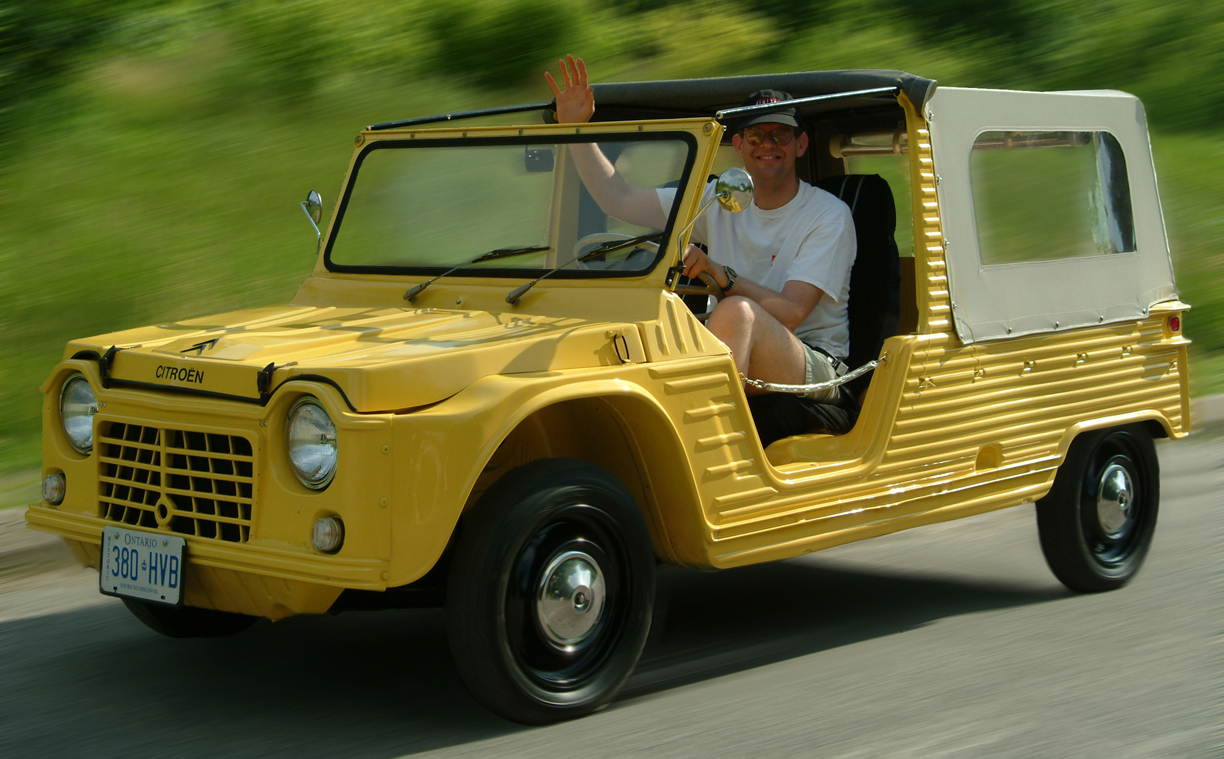
Thank you for the thoughtful illumination of this subject! My 1957 2cv has all the features of an early North American import : a speedometer in miles per hour, a cute little owner’s manual in English, and sealed beam headlights. I disassembled my headlight buckets when the repaint was done, and discovered , to my amusement, that the headlight buckets were made by Dietz, which I recognized as the same ones used in my father’s Ford Golden Jubilee tractor. It is a fun little memory connection to another vehicle I drove as a garçon.
I’m just tickled that Richard had an opportunity to tip his hat to Chris!
My Canadian 1970 D Special had European lights, while my 1971 DS21 had sealed beams. I converted the DS21 to European lights when I restored it. The Euro lights were great on the highway, but I found it curious that the smaller turning lights had such narrow beams.