
The Restoration of Brian’s 1972 Citroën DS21 Pallas Jubilée: Part 2
By Will R Hodgskiss….
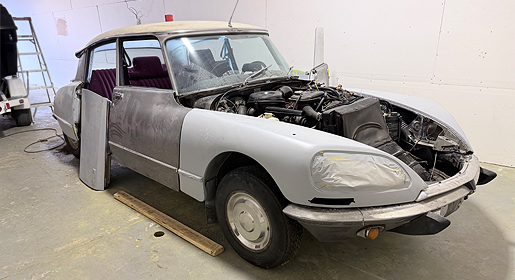
Welcome back to Update #2 on the restoration of Brian’s 1972 Citroën DS21 Pallas Jubilee.
Thanks to Bernard, a top-notch specialist, we’ve been making steady headway. The weather certainly hasn’t been our friend this year, but it’s not stopping us.
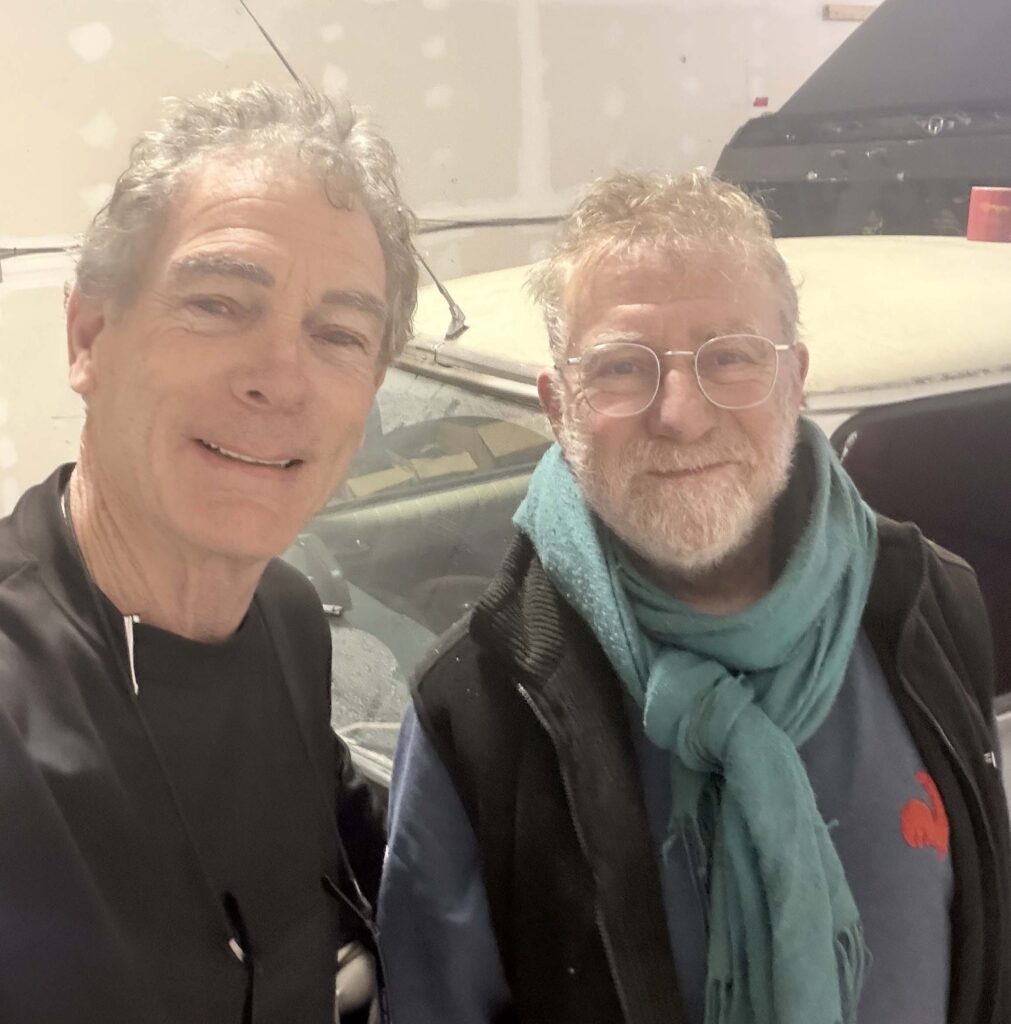
Early this year I found a fuel tank specialist in Ottawa, Capital & Dominion Radiator Co who could clean, repair, and coat the fuel tank for $800.00. It seemed like quite a bit, but it was fair in comparison, and they were a pleasure to work with. Pat’s Radiators in Kingston on the other hand gave me nothing but a runaround. BTW you wouldn’t believe how hard it is to get rid of the smell of gas in a car. Despite the tank being double-wrapped in overlapping large garbage bags, I managed to spill just a bit (in my wife’s Macan) on the way to the repair shop.
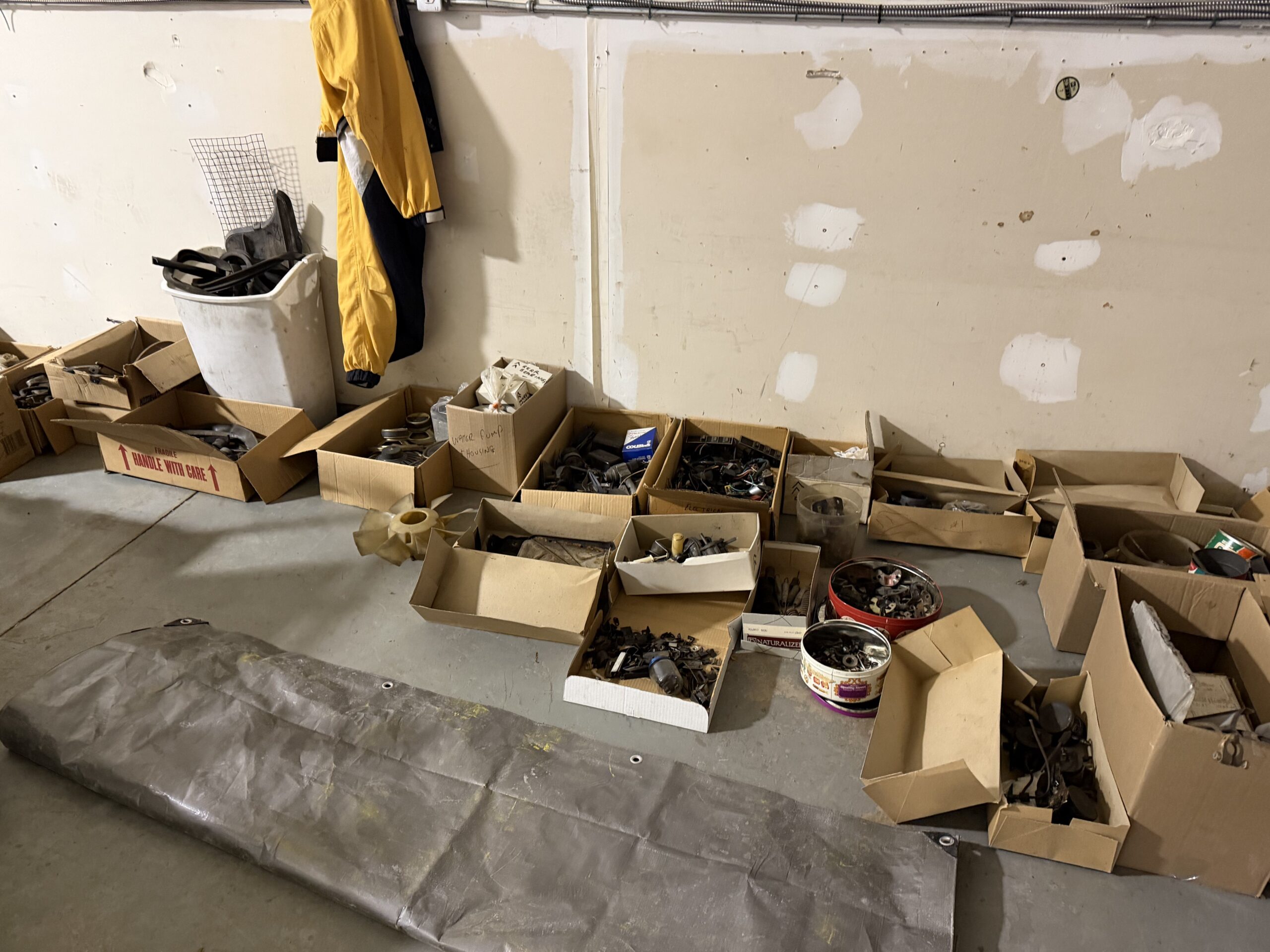
Around February 10th, I drove to Jean’s home in Burlington. As you’ll recall, Jean is the lovely lady who, along with her family, made the car available to me. My mission in Burlington was to collect the many boxes of parts that Jean’s husband, Brian, had carefully labelled and stored. He had painstakingly saved every screw, bolt, cotter pin, piece of trim, spare unit, window crank, windshield, hubcap, rim, rubber seal, decorative trim piece, brake component, and cable imaginable. It’s unbelievable. And Brian Jr. had added additional notes to make identification even easier.
Jean kindly served coffee and cookies for Brian and me: four ginger snaps and four chocolate chip cookies. I was grateful, for after a nearly four-hour drive I was absolutely starving. Fortunately, an appliance repairman arrived to fix Jean’s dryer at the exact moment the cookies arrived, so Brian went downstairs to oversee the repairmen. This gave me unrestricted access to the cookies. As much as Brian Jr. is a fine fellow, I managed to eat “my” four cookies plus two of Brian’s, while enjoying a pleasant conversation with Jean, and hoping Brian wouldn’t notice when he returned. I would have liked all eight, but I didn’t want to get carried away.
Brian, and I loaded dozens of boxes containing hundreds, if not thousands, of parts, into a trailer and the back of my SUV. We strapped everything down and covered it with tarps, which proved wise because it snowed heavily near Kingston on the drive back.
Bernard and I had the opportunity to go through the boxes a few days later. His first observation was that we could likely build another DS from all these parts.
It feels as though we’re edging toward a car that can be safety-certified reasonably soon. Bernard has installed several new components, and the car now starts at the touch of a key. It’s incredible. After 25 years, it fires up almost as if it were new. Then after a few more minutes at idle it settles in just as it should. Credit again goes to Brian for regularly turning it over and keeping it loose.
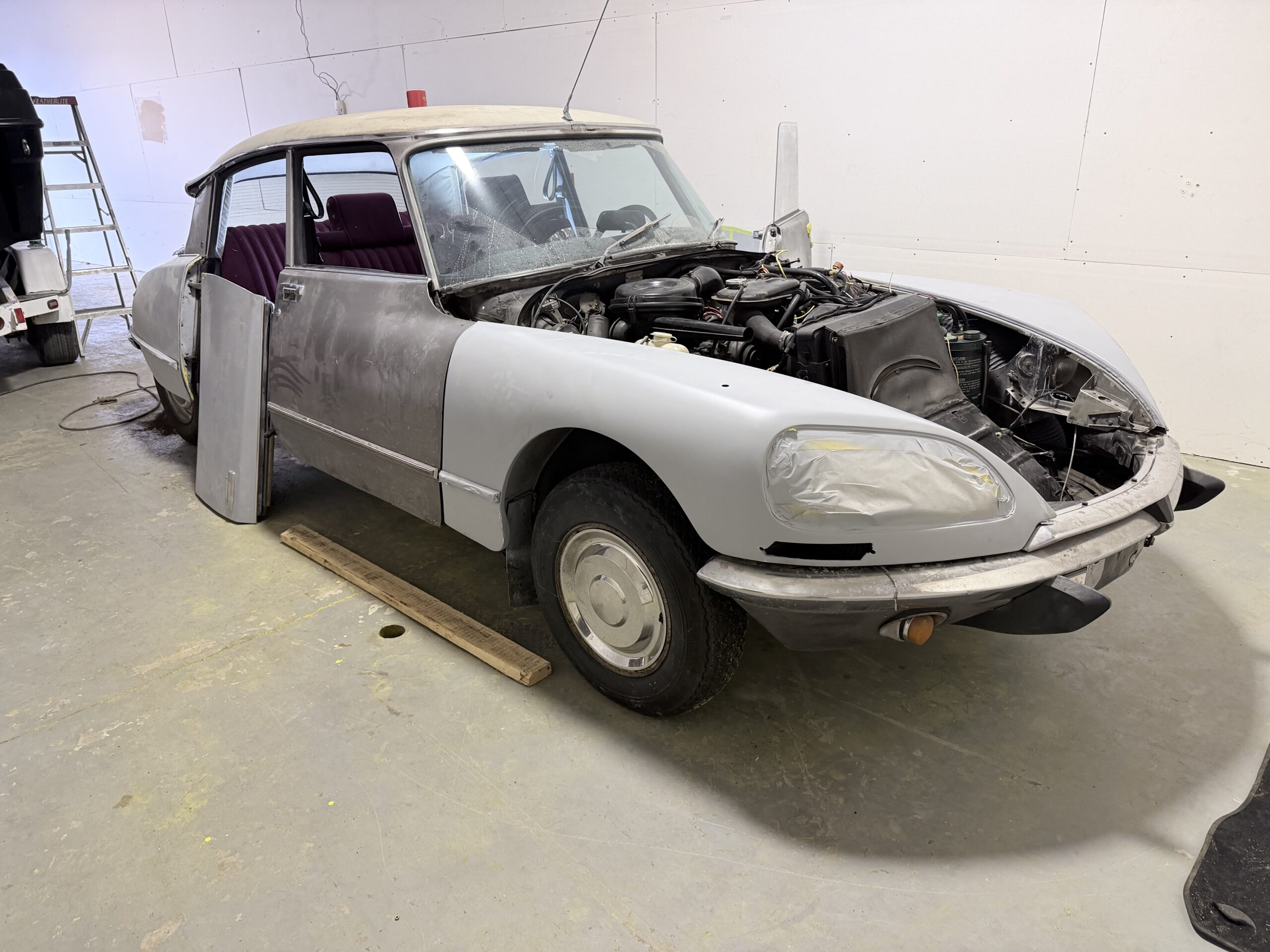
There haven’t been as many surprises as I expected. There was concern about the frame, but while it’s not perfect, it’s in solid condition. Some of the bodywork performed over the past 54 years is questionable. A few riveted repairs will need to be removed and redone. Two rear turn signals on the fender, a US-look alteration that was someone’s idea of an improvement, will be properly patched and returned to the original Canadian-spec look.
At Bernard’s recommendation, I sourced lower rear door panels and several ancillary parts from suppliers in France and Germany. The parts weren’t overly expensive, the service was excellent, and delivery took only a couple of weeks.
I had a body mechanic lined up who claimed to have the experience and time. After some enthusiastic discussion, he planned to work evenings and weekends. Unfortunately, he never showed up again. Apparently, he read my first article that George had published in Citroënvie. It spooked him. Excuses were offered, but I suspect he realized the job was beyond his comfort and skill bracket. Perhaps it was better for all concerned.
As has often been the case in my life, adversity brings opportunity. In searching further, I connected with a truly excellent auto body professional, Daniel of “Auto Spa Kingston”, who happens to be a tenant in a plaza I own at 780 Burnett Street in Kingston (343-580-1390). Daniel and Iris, the proprietors, are consummate professionals. They came to Canada from Acapulco, Mexico 5 years ago, seeking a safer and more stable life. They’ve built a flourishing business here. Daniel is rarely not busy. Fortunately, Daniel agreed to fit us in.
I enjoyed removing the rear doors and fenders myself. I’ve worked on Volkswagen beetles, Fords, a Sunbeam, Minx (I am not making that name up), Jags, Alphas and many vehicles in between. Never in my life have I seen a car-not even a bicycle, where a fender could be removed with a single bolt in about five minutes! Indeed, the DS fender comes off by removing one large bolt at the very rear of the fender (visible from the outside), pulling it slightly backward, and lifting it free. Clever engineering. The doors are slightly more involved. One hinge bolt is loosened, not removed, the door is lifted upward and outward, a small lower cantilever must be wiggled free, ideally with an extra pair of hands. Neither piece is particularly heavy.
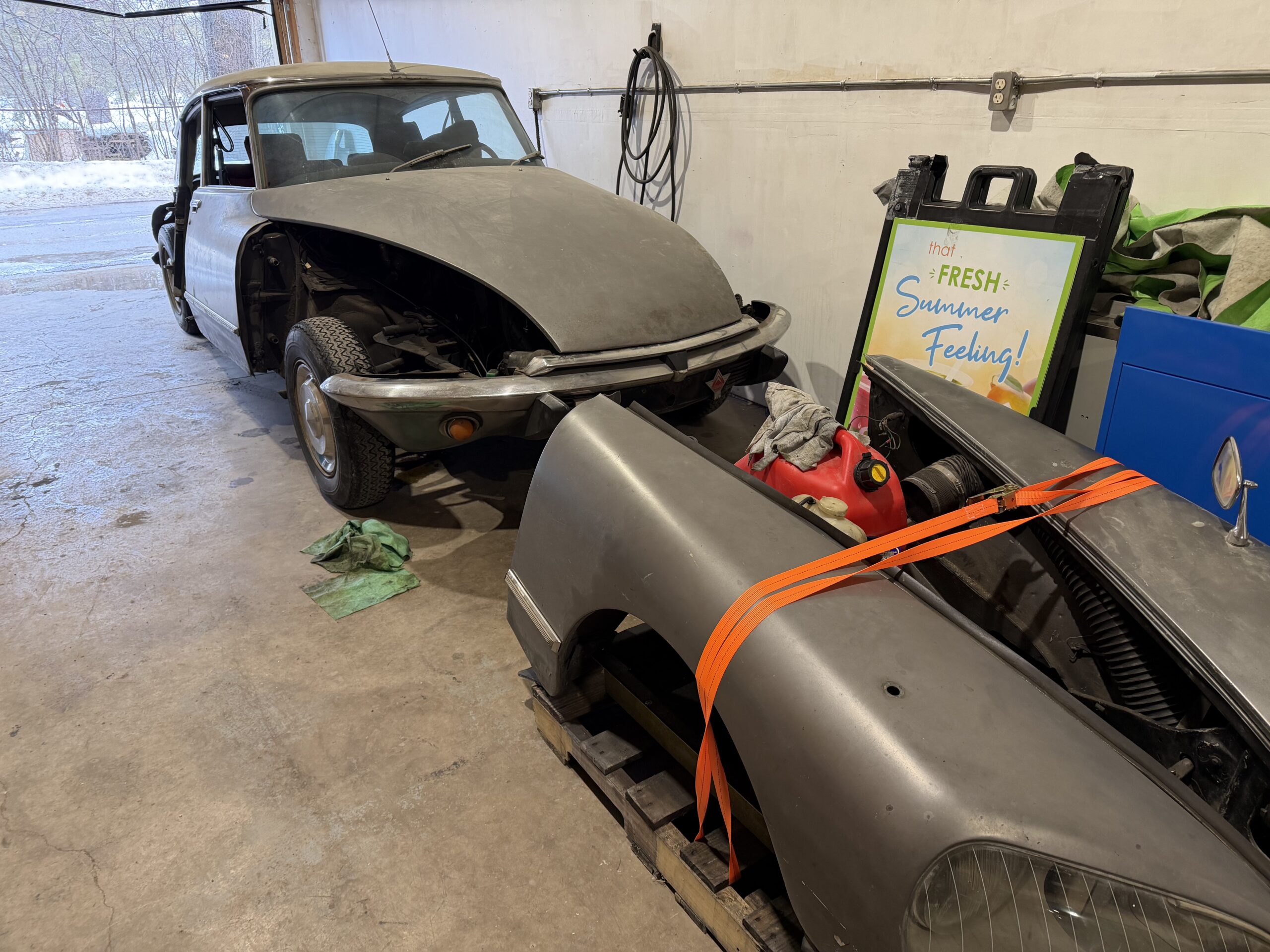
I was able to load both doors and both fenders into the back of my Tesla to deliver them to Auto Spa. Auto Spa expects to have them all primed within about 3 more weeks.
We then turned to the brakes.
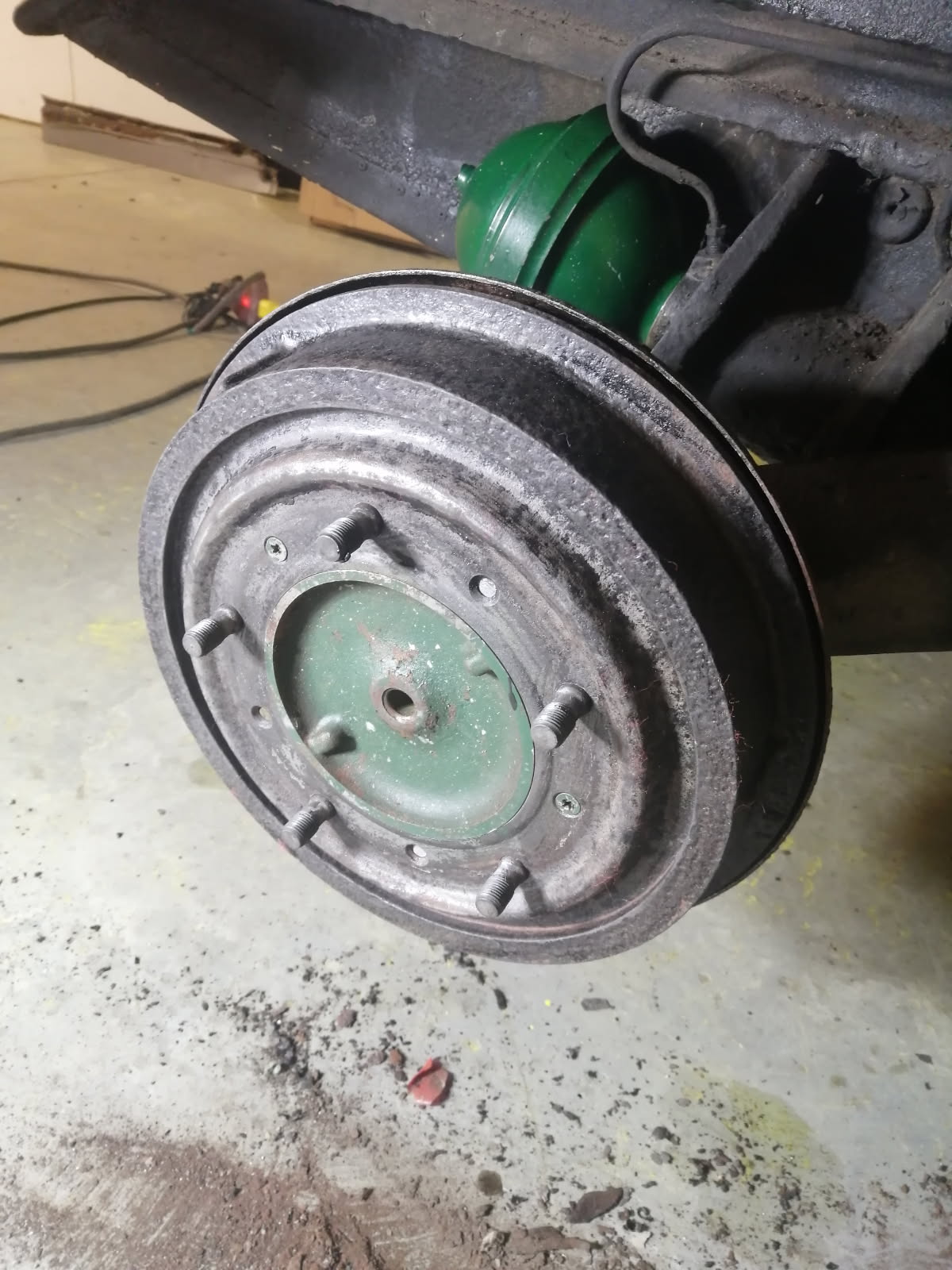
By “we,” I mean Bernard worked, and I stayed respectfully out of the way—due to a traumatic incident involving the brake job I did on my high school-era 66 Volkswagen Beetle, the 401, and what I can only describe as a spontaneous brake system disintegration at highway speed during rush-hour. That I am here is a miracle.
Since then, I believe in professionals. Strongly.
Below is some of what Bernard (and I) have accomplished most recently
- Remove fuel tank.
- Remove rear drums both sides to take off rust.
- Clean the plates and the shoes.
- Apply rust killer
- R & R rear boots.
- • Remove and clean the fuel filter. The filter is a 60-Washer Masterpiece. (The fuel filter contains sixty tiny brass discs. Sixty. Each one must be cleaned. Individually. I assume the original engineer loved puzzles. It lasts forever, by the way.)
- Clean the location of the fuel tank
- Cure the rust, paint & apply rust protection
- Paint the fuel tank area.
- Replace fuel tank.
- Clean the fuel tube and sending unit
- Reconnect the tubes.
- Replace sending unit and the fuel filter.
- Reconnect fuel lines to pump.
- Start the engine.
- Remove fenders and doors.
Additional Work Completed
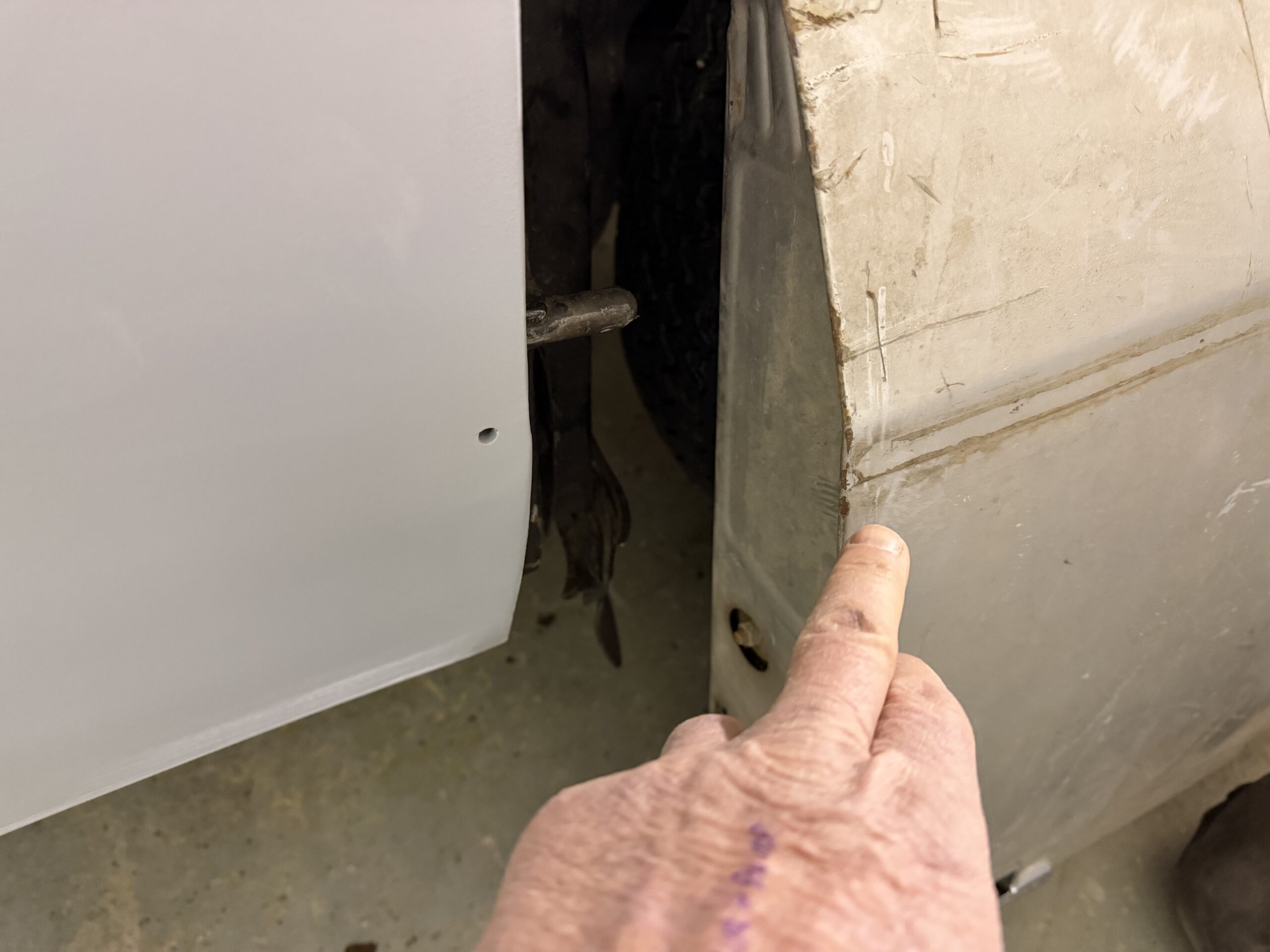
The rear doors were in terrible shape at the bottom, as shown in the photos. The stainless trim has suffered from corrosion. Fortunately, Brian’s parts collection includes replacement trim pieces.
There have been minor cracks in some rubber components, including the rear suspension boot. Small issues now, but potentially major later. Thankfully, Bernard believes replacements are likely among the extensive parts collection.
The great paint debate. I casually suggested to Bernard that I was thinking of painting the car in my company colours: bright red and yellow. Bernard paused to pull himself together then gently explained—like one might to a confused child “A beautiful woman will always be beautiful,” he said, “but…” He didn’t say it like this, and surprisingly he didn’t slap me, but what he meant was that this would be a terrible idea.
So yes, we’re going original: silver-grey with a white roof. Apparently, this is what maturity looks like. BTW, I am fairly sure that Bernard and I are still friends.
For a finishing timeline, and being an incurable optimist, I had hoped for May. June now seems… honest. All told, we’re getting closer. The car runs, parts are coming together, and no one has quit (recently).
Progress continues….
Thanks so much for keeping us in the loop! Greg