
The Case of the Mysterious DS Model
By Chris Dubuque….
(This is an updated version of the article originally published in Citroënvie on April 11, 2025.)
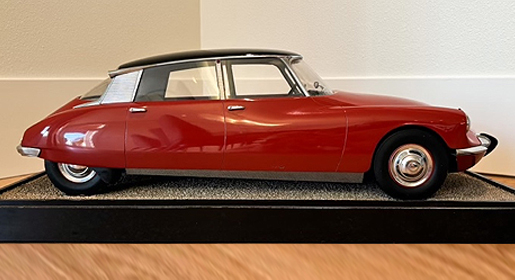
Back in the 1980’s, I visited the home of a Citroënthusiast in Portland, Oregon named Bill Lonseth. He lived in an old white house a few blocks east of the Willamette River, not far from downtown Portland. I remember that every corner of his house was crammed with Citroën memorabilia, but there was one piece that stuck with me. It was a large-scale model of a single-headlight DS, about two feet long (600 mm). It was red with a black roof. Such large-scale models were rare in the 1980’s so it remained in my memory. I would not see this model again for 40 years.
BILL LONSETH
Before we get to the model, let’s take a quick look at who Bill Lonseth was. Bill became involved in Citroëns at an early age and by the late 1960’s, he had landed his first automotive job working for a Citroën dealership in Springfield, Oregon called, S.L. Motors. This dealership handled several marques, including Citroën, Peugeot, Renault, Studebaker, Mercedes, and Datsun. Within a year or so of working for S.L. Motors, Bill was hired by Citroën Cars Corporation to help run the parts department at Citroën’s west coast headquarters in Beverly Hills.
Bill worked at Citroën L.A. for several years, but around 1974, as Citroën was starting to wind down their operations in the USA, Bill moved back to Oregon to work for Portland’s Citroën dealer, Roger Sagner’s Motor Mart.
Sagner’s operation then began ramping down in the late 1970’s and therefore Bill needed to look for another job. After Sagner’s, Bill spent five years in London working for a Citroën dealership called, BWB Motor Services. However, he kept his Portland roots and returned there after his London experience.
By the early 1990’s, Bill had pretty much retired. For his remaining years, he hung close to his Portland home. Bill’s health gradually slipped away and he died in early 2023.
THE ESTATE
It turns out that Bill did not have many close relatives, so after he passed away, a person with an automotive background was brought in to help liquidate Bill’s cars, memorabilia, and parts. This estate manager contacted the local Citroën club (NWCOC) and offered many of Bill’s belongings to club members. This is where my memory flashed back to the 1980’s and the red DS model. I asked the estate manager if the model was still available and he said it was. Without hesitation, I bought it from the estate, having not seen it for nearly 4 decades.
THE MODEL
I was quite stunned how substantial the DS model was. It is 24 inches long (600 mm) which makes it 1:8 scale. It is quite heavy – I carefully turned it over and found that much of its structure was wood. The level of detail is astounding, very uncharacteristic of toys of the era. It was mounted on a wood base, with scale-appropriate gravel. At this point, I was beginning to think that this model might be something really special.

MARTEN BOERSMA
Some number of years ago, I bought a book that catalogued virtually every DS toy that was ever made. It is called, Citroën DS in Miniature, written by an old friend, Marten Boersma. This book has over 450 pages and thousands of photos of DS toys and models, listed in alphabetical order by manufacturer.

I looked through this book to see if I could find this particular model and I did find something similar, but it was not made by any of the toy manufacturers. Instead, the manufacturer is listed as Citroën. More specifically, the model is listed in the book under the heading:
Citroën: Flaminio Bertoni, France, Prototype and style exercises
Does this mean that Bill Lonseth’s red DS model was built inside the secretive walls of Citroën in Flaminio Bertoni’s studio? I decided to email Marten Boersma to see what he thought about Bill’s red DS.
For many years, Marten Boersma has had access to Citroën’s archives and he has been slowly building a detailed history of design concept models, wind tunnel models, and display models that Citroën built in-house in the early days of the DS. The rediscovery of Bill Lonseth’s red DS re-ignited Marten’s research into Citroën’s early model making. The following is a brief version of Marten’s story about a few of these models, including Bill’s red DS. Note that Marten is still researching these, so more details may eventually emerge.
It turns out that Citroën built several 1:8 scale models for 3D visualization and wind tunnel testing. These models were made from wood, fiberglass, and plasticine (a form of clay). The internal structure and wheels/tires were made of wood. A resin-impregnated cloth was put in a mold, followed by layers of plasticine. When it came out of the mold, the craftsmen added more detail by hand.
Marten has also researched the people who built these models. One name that comes up frequently is Henri Dargent. Dargent was hired by Citroën in 1945 and by 1953 he was working in the design office. In an old interview, Dagent indicated that Flaminio Bertoni requested that he work directly with him and by 1957, Dargent had become Bertoni’s right-hand man. Dargent is said to have been a talented model maker and it is likely that he had his hands on some (or all) of these models. It is to be sure that there were countless others who worked on these models, but their names are yet to be rediscovered.

Below is a brief history of a few of these incredible models.
MODEL #1
This all-wood model is thought to be a “master” and therefore is the oldest of the models discussed here. It was made in Flaminio Bertoni’s workshop, by Flaminio himself. It has been shown in various museums in Italy, and now is located in Museum Volandia, near Milan.

MODEL #2
A beige wind tunnel model has also survived. This is one of the models that was made using the molding process discussed above with fiberglass/wood/clay. Notice that it has a very accurate front bumper installed on an otherwise featureless body. You can barely see it in this photo, but it has an accurate rear bumper as well. (The bumpers were probably added later.)
Marten thinks that this model was made very soon after Bertoni had finalized the DS’s roofline and rear window, something that happened quite late in the development of the DS. Notice it does not yet have the roof-mounted turn signals.
If you look closely, you can see small holes at the bottom of the tires. Marten indicated that these holes were used to secure the model in the wind tunnel.

MODEL #3
Marten found this long-forgotten green model stored in a box in Citroën’s archives. It is believed to also date from late 1955, perhaps cast at the same time as #2, but was never retrofitted with the realistic bumpers, or other parts.

MODEL #4
In addition to the above, Citroën also built three display models, using the same molds and build techniques. These models started out the same as #2 and #3 above, but had many, many hours of additional hand-detailing to make them suitable for display purposes.
Model #4 was originally painted Champagne with an Aubergine roof. It is not known when it was made, but probably quite early (perhaps in late 1955 or early 1956). This model is much more detailed than the wind tunnel models and includes door handles, bumpers, windows, exterior brightwork, and a full interior.
Model #4 is the one that was used for a series of early DS publicity photos with the little boy.

Marten discovered that this model still exists, and has been sporadically on display in Citroën’s Conservatoire. Probably in 1962, Citroën converted if from the first-generation nose to the second-generation nose for the upcoming 1963 models. At this time, it was repainted light blue. Marten indicated that if one looks at it closely, you can see that in places where the blue paint has chipped off, it reveals the original Champagne color underneath.

MODEL #5
Another display model is one that was photographed in Pierre Bercot’s office. Bercot was Citroën’s managing director at the time. This model was originally painted Green with a Champagne roof.
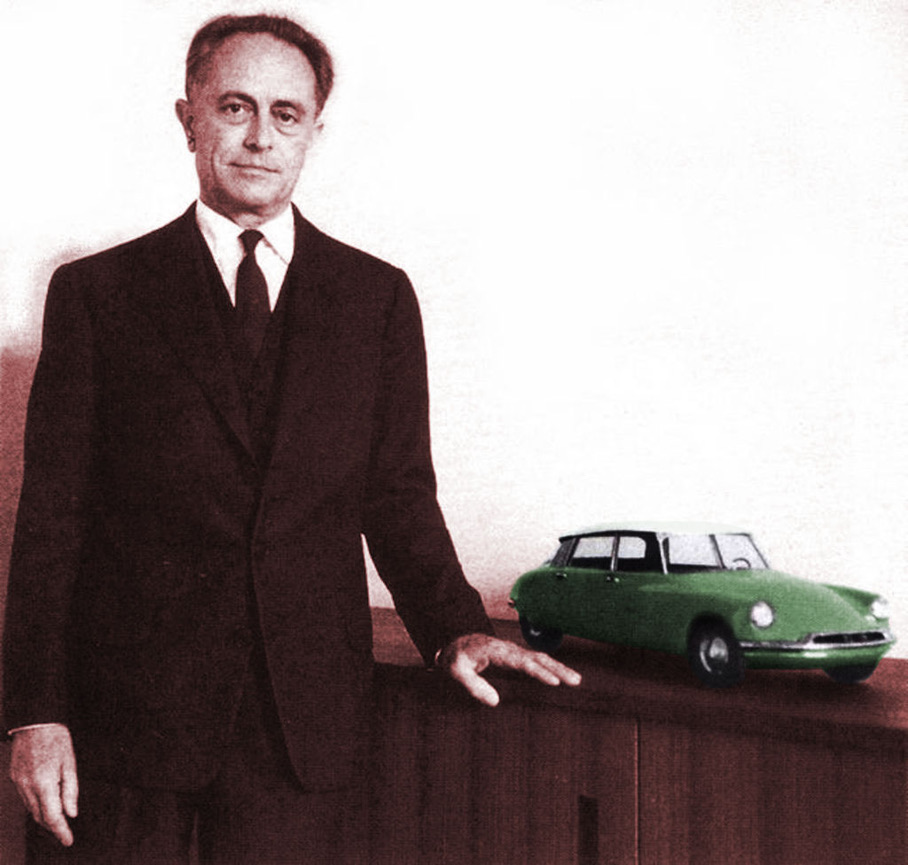
Marten discovered that this model also still survives, but it has been significantly modified. Sometime in the early 1960’s, Citroën converted it into the vertical rocket ship motif that Citroën was intrigued with at the time for marketing purposes. It also had the front end converted to the second-generation nose, which was new for 1963 and was repainted silver. (Although it was modified to have a second-generation nose, it still has the first-generation dashboard, a clue to its earlier roots.)
Citroën still owns display model #5 and it was most recently displayed at Retromobile 2025, right next to its full-sized equivalent, which has also survived (although the full-sized version is no longer owned by Citroën). It is theorized that this model was converted to a rocket ship as a concept to show management before the full-sized version was approved.


Model #5, now silver, with a new nose, and turned into a rocket ship. It is sitting next to the full-sized version at Retromobile 2025.
Model #6
This brings us to model #6. Marten had been aware that another display model may have existed, but he wasn’t sure. Well, he wasn’t sure until I sent him detailed photos of Bill’s red DS. Marten was excited and astounded. Flabbergasted would be a more appropriate word. It is indeed one of Citroën’s in-house models, built from the same molds as the others shown above.
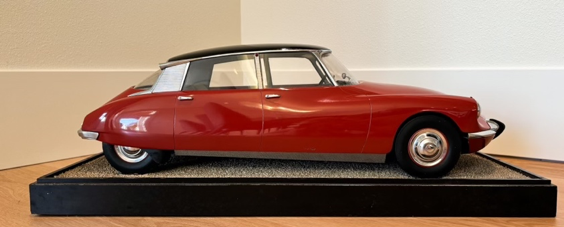


Model #6, red with 2nd generation nose and new dashboard.
Bill’s model is a bit different from display models #4 and #5 since it has no indications that it started out with a first-generation nose or a different color. These observations suggest that it was most likely made later than all of the others, probably in 1962 in preparation for the new 1963 models. It was likely built at the same time that #4 and #5 were being modified to have the second-generation nose.
HOW DID IT END UP IN PORTLAND?
These models were most likely never intended to leave the secretive walls of Citroën’s headquarters. They were undoubtedly very expensive to create, since they were 100% hand made by craftsmen in Citroën’s design studio. They were built for wind tunnel testing or for internal design reviews. Remember that back then, hand-made sub-scale models were the only practical way to show your bosses a 3D view of the teams’ creations, short of building an even more expensive full-scale mock-up.
How did this particular model slip out of Citroën’s hands and end up in Portland, Oregon? Well, we may never know the full story, but we do know a few details. And since the first release of this article, a few more details have emerged.
In 1966, the Museum of Modern Art in New York City (MOMA) held an exhibit called, “The Racing Car: Toward a Rational Automobile.” Citroën had a small display at this exhibition which mainly consisted of a model of a DS in a case and a photo on the wall.
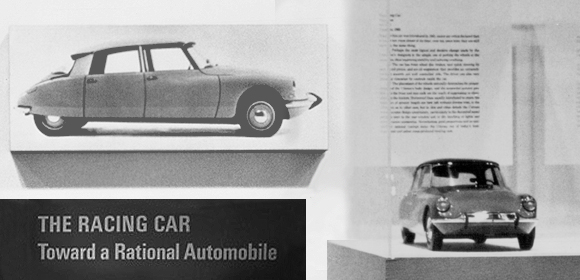
If you look at photos of the model shown at New York’s MOMA, one can see that it has a second-generation nose, a full interior, a mid-tone color, and a dark roof. By process of elimination, there is only one model that fits this description – Bill Lonseth’s red model.
Since the first release of this article, we now think we understand how Bill’s model ended up in the USA. It seems pretty clear that Citroën shipped the red DS model to New York for the MOMA exhibition. Furthermore, it is likely that MacDonald Leach (Citroën’s main marketing man in the USA at this time) was involved in this effort, since he created a press release about the MOMA exhibition. You can read about the exhibit and read the press release here: https://citroenvie.com/first-citroen-ds-exhibit-at-moma/
Fast forward a few more years. By 1974, it was clear that Citroën was finished with their North American adventure, and they were starting a gradual decline of their operations. This is where Bill Lonseth comes in. In 1974, Bill left his job at Citroën L.A. and decided to head back to Oregon. Bill was able to take with him a bunch of memorabilia from Citroën L.A. that they no longer wanted or needed. One such item was…..the red DS model. It sat is Bill’s living room for the next four decades.
When Bill’s estate was being cleaned out, a photo emerged of Bill holding the red DS in front of his Portland house. I suspect this photo was taken in the late 1970’s.

Fortunately, Bill took very good care of this model. It is in better condition than the two display models that Citroën owns, both of which have been handled more and have a few battle scars.
What I have shown above it not a complete story. Marten has many more photos and additional details of Citroën’s in-house models and I understand he is working on a new book. I can’t wait!
For now, this model will be displayed in our living room, under a new plexiglass cover that I had custom-made to fit the original base. For now, I will be a good steward by keeping this interesting piece of Citroën history safe. I would like to thank Marten Boersma for helping uncover the history of Citroën’s early models.
Is there a chance that Citroen will bring back to the market the Ds21 with is iconic look from the 70’s ? That model was flawless. Now in days all cars look the same. Keeping my fingers crossed to ride the car my father drove so proudly when I was a child.
I certainly hope some carmakers will see fit to make some beautiful, unusual new electric cars. This model would be appropriate, as there is room for batteries and associated equipement necessary for a modern EV to obtain sufficient range.
Chris,
Thank you greatly for sharing the tale of the red DS model. My 1st D – a 1970 DSpecial – came from an estate in Portland, where we lived for some years. Via via I found Bill, who became my shadetree mechanic extraordinaire. The resurrection of the DSpecial took several months of Bill’s attention, and eventually was almost roadworthy enough…it drove one-way to Eugene on its maiden voyage, but sadly on a tow truck for its Portland return, straight to Bill. You in fact rebuilt the steering rack, as for serious stuff it went up to Seattle to the ‘other’ Chris’s (RIP.)
We enjoyed the DSpecial for some years, but an eventual lack of garage space lead me to sell to a fellow in California. And now for the bizarre twist – just this am I saw my old DSpecial on ebay, worse for time and wear, but hopefully soon to make a return to its former glory. I did see your model in Bill’s house once (usually was not allowed inside for Bill’s comfort sake), but did not ask about it. Congratulations!! And it could not land in a better place than with you.
I remember Bill showing me this at his home in the 1990s along with a his other collection. Like you it stuck in my memory as being unique, it’s really the only thing I remember from his collection now. I know we talked about it and I wish I could remember more other than he was very pleased to have found it. Great research Chris and it couldn’t go to a better home.