
Why Were Single-bolt Rims Discontinued on Early DS and ID Models?
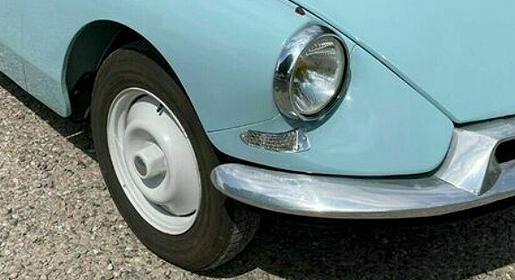
Citroënvie member Peter Fyfe observed that he hasn’t come across a technical article on single bolt rims on early DS and ID models anywhere and wondered why they were discontinued. As Peter observed;
“Clearly not for the ability to balance tires since what followed with either the little square or round center hole wouldn’t mount on a conventional balancer anyway. I thought the system with expanding hex was brilliant!. Did any other cars have similar methods? Was Citroen’s rim design patented? I once walked several miles using the wheel wrench to roll the wheel in front of me wheelbarrow style to reach a repair garage.
Did the rally cars have problems of strength? Particularly in cornering? The braking horsepower the mounts tolerated would have been five to seven times greater than tractive power and the only weakness in the system seems to have been the drive dowels in the front hubs.
If the ring nut wasn’t fully tight (288 ft. lbs.) the dowel holes would wear oval and the car could be rocked to and fro with the brake on. A cause for alarm to crew on small ferries!
British Rudge wire wheels had a similar problem: The splines of the drive wheels would wear and no amount of pounding on the wing nut with a lead hammer would secure the wheel. The non-drive wheels could suffer corrosion and virtually no puller was capable of getting the wheel off the splines.
Maybe Ken Nelson or someone else capable would provide a write-up on Citroën with an aside on wobbly washer wheel nuts.”
First off; Pre 1965 DS and ID models had single-bolt rims and were fitted with Michelin 165 SR 400 Michelin X tires. After 1965 Citroën moved to 5 lug nut rims.
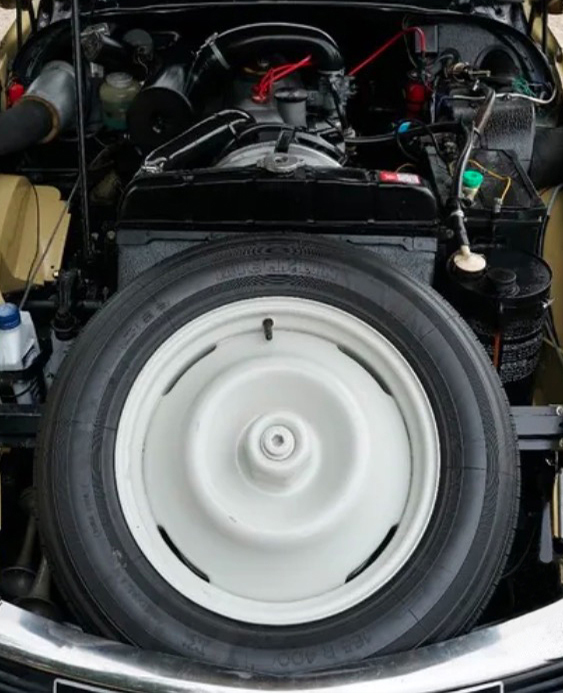
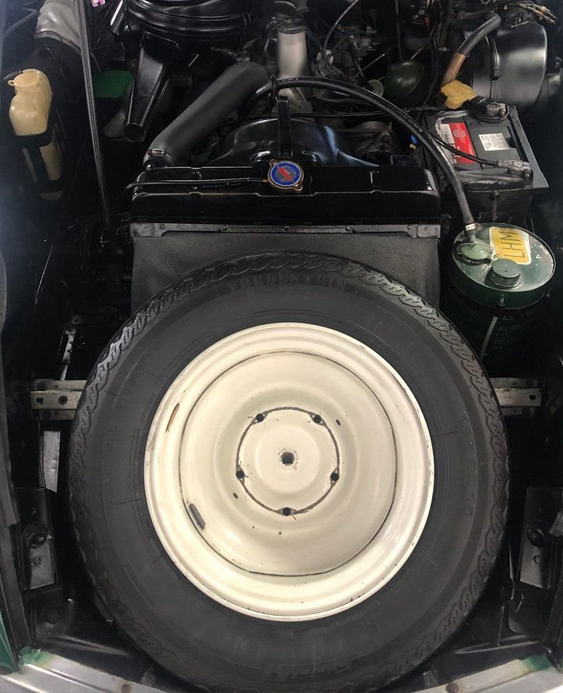
As far as we can tell, The “single-bolt / single-nut” (one central lug) wheel arrangement was essentially a Citroën-specific feature of the DS/ID range:
We previously touched on Citroën’s single bolt/single nut rim subject in this article in Citroenvie where Ken Nelson said that the DS single bolt rims were outmoded and more difficult to manufacture. We asked Ken to expound on that and here is what he came back with:
“I’ve seen issues with ALL the wheel attaching systems. None are perfect if the attaching isn’t done properly, meaning getting the fastening torque sufficiently high, whether by “feel” or using a properly working torque wrench.
If you look at the complexity of machining the wheel bearing center of the single-bolt Citroën design rim, it’s hard to tell if this part – which is the center race of the wheel bearing itself, and the connecting joint between the bearing, driveshaft and rim itself – starts as a steel/iron casting, or hot forging. It is a very complex part, but then Andre Citroën’s company started out making munitions for France and Europe during WWII. They made millions of shells and knew how to make strong hardware in high volumes.
Combine the complexity of the single-bolt hub, with its 3 sections designed to flex a small bit when expanded by the center tapered disc pulled outward by the rim bolt, with the deep draw of the center of the rim, and it takes very heavy duty manufacturing tooling and machines to form these two parts. Compare them to the simple 3-5 stud wheel rims prevalent today, and the manufacturing cost difference had to be very high.
However, having had NSU cars with splined drive wheel hubs mating with brake drums/discs (held on by a single “knock-off” wing-nut like many British collector cars), I’ve learned that the very small clearances used during manufacturing to keep the hub splines snug to the brake hubs yet allow easy attachment, always allow a small amount of slop movement which occurs during stopping/starting if the single “nut” isn’t sufficiently tight. And if the attaching nut/knockoff wing-nut is not VERY tight, a tiny amount of relative movement between the driving hub and rim mount can cause back/forth rocking movement wear to the point of requiring the replacement of both the driving hub and driven hub, such that the relative movement can loosen the clamping “nut” and cause loss of a wheel!
I know friends who have lost wheels on their VW rear spline drive, and my NSUs got very sloppy over time and had to be replaced. And how many times have British car owners lost a wheel or replaced sloppy fitting parts on Jags, MGs, etc?
Multi-lug studs I think can give better early warning than knockoffs or even Citroën’s single-bolt rims. How do I know? When I first bought my 1963 DS19 Cabrio and had to drive it home, a short drive from its barn to a Dairy Queen made me question the tightness of the right front wheel. So, after the ice cream, I grabbed that wheel and tried to physically rock/shake the rim on the hub. I did this by rhythmically rocking the rim back/forth sideways and top to bottom, and it felt tight.
Then feeling secure, I drove about 300 feet and while crossing local railroad tracks, the right front wheel parted company with the car and sailed into a school parking lot! Fortunately it was a Sunday and no kids were present. The superb suspension simply reached down and stabilized the car, but ground the right front bottom ball joint nut flush with the suspension arm! Long story short, I obtained a replacement back at the car’s barn off another car and swapped the useless ball stud shank on the wheel bearing and made it home. So, even Citroen’s robust design can be improperly assembled, but 5-stud wheels should give more warning before complete failure!
PS: I love the single-bolt rims, as when I started ice racing on the frozen lakes north of Chicago with an early car. I could swap on my homemade studded Michelins way quicker than any other car, and of course with the integrated jacking plus the single-bolt rims — that ability blew the minds of the other guys I was competing against! Both John Chassin and I had great fun in the ’60’s running on Lake Geneva next to the Playboy Club north of town.”

Maybe we can get a future story from Ken on just how much fun he and John had with Playboy Club bunnies!
Aren’t F1 race cars single hub?