
DS Automobiles Returns to Citroën
Yesterday at Stellantis Investor Day in Auburn Hills, MI , CEO Antonio Filosa laid out “FaSTLAne 2030” — a new five‑year strategic plan worth €60 billion that targets positive free cash flow by 2027 and annual cost savings of €6 billion by 2028.

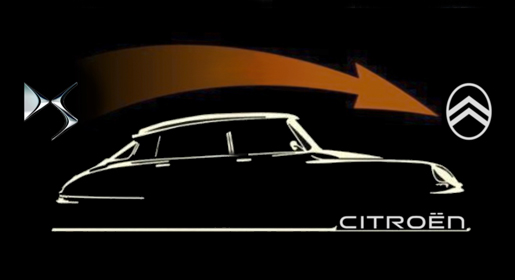
Under the plan, Stellantis will not eliminate any of its 14 automotive brands, but the operations of DS Automobiles will be folded into Citroën — ending, to some extent, objections from many Citroën enthusiasts who felt the DS name was wrongly taken from Citroën when DS Automobiles was created. The independent DS marque was launched in 2014, and references to the iconic DS and SM were removed from Citroën at that time.
Implementation details for DS Automobiles’ return to Citroën were not announced. Filosa said FaSTLAne 2030 includes €36 billion allocated to the company’s automotive brands, with 60% of that investment expected for North America; the remaining €24 billion will go toward global vehicle platforms and new technologies.
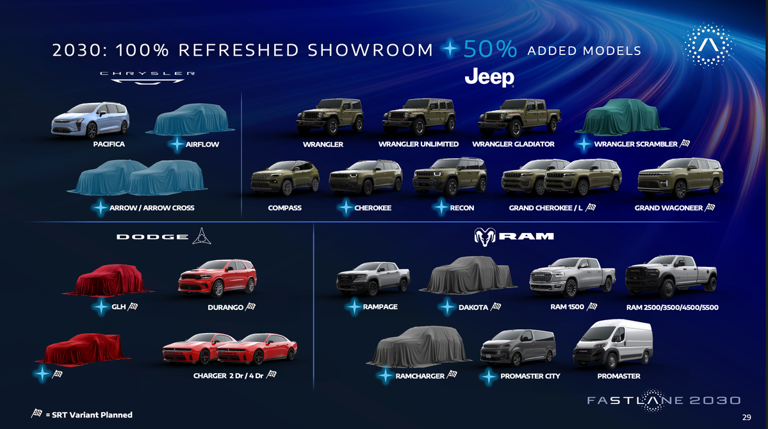
The company expects to introduce 60 new vehicles and carry out major refreshes of 50 models, including all‑electric vehicles, hybrids and internal‑combustion variants.
Stellantis will refocus its 14‑brand portfolio: 70% of brand and product investment will go to Jeep, Ram, Peugeot and Fiat, as well as the commercial‑vehicle unit Pro One. Other brands — including Citroën, Alfa Romeo, Opel and Vauxhall — will be repositioned more regionally, while Lancia will be folded into Fiat. In North America, Chrysler and Dodge will remain alongside Jeep and Ram.
Citroën will remain in markets where it currently has established share and profitability. Citroën is generally profitable in Western Europe and parts of Latin America (notably Brazil and Argentina, where local production and the C‑Cubed strategy have improved margins); it has historically been loss‑making or lower‑margin in China and some other Asian markets but is growing in India. (C‑Cubed — written C‑Cubed or C‑3 — is Citroën’s program to design, locally engineer and locally produce a family of affordable B‑segment cars and small SUVs tailored to fast‑growing emerging markets.)
Within Citroën, DS Automobiles will become a specialty brand managed under Citroën’s umbrella (product, commercial and regional organization) rather than operating fully independently. DS will concentrate on core premium markets (primarily Europe and select premium pockets worldwide) while leveraging Citroën’s regional footprint for distribution and dealer networks. DS has been most successful in Western Europe (France and several nearby EU markets) and earlier saw notable acceptance in China — although performance there later weakened and DS reduced its presence. It has also had pockets of success in the Middle East and selected premium urban centres.
Stellantis introduced STLA One, a modular vehicle architecture designed to support multiple powertrains and vehicle sizes. STLA One will be 800-volt capable, have a modular, scalable architecture with common interfaces to reduce complexity, speed development and targets 20% cost efficiency, driven by modularity by design and new battery choices;
- STLA One launches in 2027 and is designed to bring together five different platforms into one scalable architecture, reducing complexity and expanding coverage
- STLA One to cover B, C and D segments
- STLA One targets 20% cost efficiency, driven by modularity by design and battery choices
- STLA One is Stellantis’ first platform slated to integrate STLA Brain, STLA SmartCockpit and steer-by-wire technology
- STLA One is designed to grow into a mega platform supporting 30-plus models and targeting more than 2 million units by 2035
- By 2030, Stellantis targets 50% of volume on three global platforms, with up to 70% component reuse
According to Stellantis, both Citroën and DS will use shared platforms, powertrains and technology stacks (STLA One, STLA Brain/SmartCockpit/AutoDrive) to lower development costs and accelerate launches, while preserving DS’s premium differentiation in design, materials and features. It forecasts that by 2030 50 per cent of its global annual volumes to come from just three global platforms, including the new modular ‘Stella-One.’
The strategy reflects a growing reliance on partners to share costs and accelerate development, particularly in expensive areas such as software and autonomous driving, while Stellantis is seeking to turn a long-standing weakness – excess European manufacturing capacity – into a source of revenue by offering contract production to third parties, rather than bearing the cost of underused plants. New partnerships include production tie-ups with Chinese groups Leapmotor and Dongfeng, as well as cooperation with Tata Motors and its JLR (Jaguar Land Rover) unit in the U.S. In technology, the carmaker is working with firms such as Qualcomm, Applied Intuition and self-driving startup Wayve.
Stellantis also announced that Citroën will launch a new model inspired by the spirit of the legendary 2CV (which they now refer to as 2 CV) at a price tag of around 15,000 euros.
True to Citroën’s DNA, the ambition is clear: to imagine the icon of tomorrow while remaining faithful to the original TPV brief that gave birth to the 2 CV. Because true innovation is not about adding more, it is about making life better and focus on what really matters.

In summary, DS Automobiles will remain a premium, niche offering but will operate more tightly integrated with Citroën, receiving targeted, smaller‑scale investment focused on profitable, high‑margin segments and electrified premium models rather than broad global expansion.
It’s about time that DS and SM branding was brought back under the guise of Citroën — and hopefully not too late for those who want a contemporary Citroën DS to be introduced.
por fin se toma una decisión con sentido y se elimina la mala gestión del peor CEO de la historia , el incompetente de Carlos tavares , hasta el.mas tonto sabía que su forma de llevar un grupo, significaba : comida para hoy y hambre para mañana
English translation of comment:
Finally, a sensible decision has been made, eliminating the mismanagement of the worst CEO in history, the incompetent Carlos Tavares. Even the most clueless person knew that his way of running a group meant: food for today and hunger for tomorrow.