

By Thomas Urban….
In addition to being the first manufacturer to inaugurate mass production of popular cars in France, André Citroën was also one of the first manufacturers to claim the status of a “European manufacturer.” During the 1920s, the chevron brand established itself in most countries of the Old Continent, mainly in the west but also in the east, as far as Poland, where it remained present until 1935.
Along with countries lacking a robust national automobile industry—or where such an industry was underdeveloped and limited to the domestic market—the Quai de Javel firm did not hesitate to establish itself in countries that were among the pioneers of the automobile industry, where competition from national manufacturers was particularly fierce.
Across the Channel, Citroën inaugurated its English subsidiary, Citroën Cars Limited, in 1923. Initially, its activity was limited to selling models produced in France on the British market, simply equipped with a right-hand drive to comply with local market legislation. However, the evolution of the British government’s policy on imported vehicles would soon change the situation. Was this due to a pronounced bout of “chauvinism”—which the English, especially at the time, did not even try to hide? It seemed inconceivable to certain English politicians that their fellow citizens would drive a car that was not English, influenced by pressure from British manufacturers and certain political leaders who considered it their duty to protect the interests of the national automobile industry. The fact remains that barely three years after Citroën arrived in the land of Shakespeare, the government in London decided to significantly increase import taxes on cars coming from abroad.
Determined to remain in the United Kingdom for the long haul and even succeed in winning over motorists in jackets and bowler hats, the chevron brand understood that the best—and perhaps the only—solution was to produce cars intended for English customers directly in England. The factory for this production was inaugurated in Slough, Berkshire. Until the Second World War, production was aligned with that of the Quai de Javel, but English Citroëns were renamed with Anglicized names and often featured specific fittings and interior appointments to better suit the tastes of British customers.
After the Second World War, when the Slough factory, like British manufacturers, was forced to convert to military vehicle production, the production of the English Traction resumed in 1946. The models were the same as those produced in France but with different names: Light Fifteen for the 11 Légère, Big Fifteen for the 11 Normale, and Six Cylinder for the 15 Six.
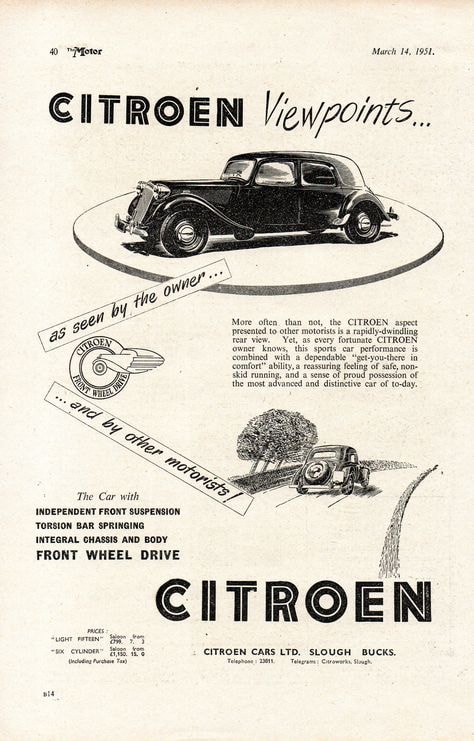
Although the popular 2CV also logically joined the British range, it did so with a delay of several years compared to the French market; production began in France in 1949 but did not roll off the assembly lines of the Slough factory until four years later, in 1953.
The famous “deux chevaux” allowed many French people to buy their first car, becoming so successful that it initially required a waiting period of around two years. However, in the land of tea and crumpets, it did not enjoy the same success. The very notions of aesthetics and comfort, at least as they were conceived before the 2CV’s launch and according to English tastes, seemed to have been forgotten when drafting the specifications. The concept of “four wheels under an umbrella,” with its resemblance to a “garden shed” or “chicken coop” on wheels, was very far removed from how the English defined a “minimum automobile.” Compared to it, even the most modest Austin or Morris appeared almost like rolling living rooms!
Realizing quickly that the style and ambiance of the Deux Chevaux’s interior might deter many English motorists, the managers of the English subsidiary attempted to make it more practical and appealing. They introduced features such as direction indicators, a steel trunk lid (the French version still had a canvas hood extending down to the rear lights), a larger rear window, rear door windows that flipped open like the front door windows, a larger front bumper, a pronounced hood emblem and a wider range of colors: white, cream, brown, and black, a significant change from the usual “sheet metal” grey with which the majority of 2CVs produced at the Javel factory were adorned.
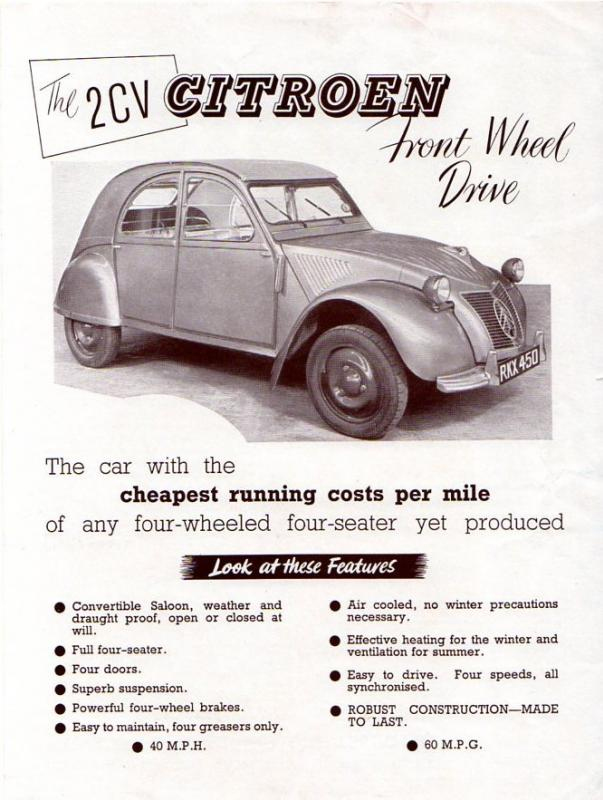
Thus equipped, the “made in England” version had the potential to appeal to more than one average Frenchman dreaming of ownership, whether they hailed from Montmartre or the Auvergne countryside. Despite all these efforts, the re-equipped English 2CV still did not succeed in convincing British customers. Clearly, in spirit and style, the 2CV was far too French to win over the English market! Under these conditions, the introduction in 1954 of a larger twin-cylinder engine—425 cc—was unlikely to persuade potential customers to place orders. Ultimately, production of the 2CV in England ceased at the end of the 1950s.
However, the management of the English subsidiary soon realized that they still had a fairly large number of 2CV platforms shipped from the Quai de Javel factory—these were simply exported to England, with the Slough factory handling only the manufacture of the bodywork elements and final assembly. Given that it was out of the question to ship them back to France, the local representatives of Citroën came up with a rather original idea to help sell the remaining platforms: to have them re-clad with a new body, specifically designed for this purpose, whose style would no longer bear any resemblance to the original 2CV.
This was therefore a “circumstantial model” intended for small-scale production, primarily to reuse the leftover platforms. Some within the management of Citroën Cars Limited believed that if this new model was sufficiently successful, it could eventually transition to mass production, thus allowing the 2CV to have a second life in the English market.
For cost efficiency, as well as ease and speed of production, it was quickly decided to use fiberglass for the bodywork components. This material, in addition to its lightness—a notable point given the low power of the Citroën twin-cylinder engine—was simpler for small-scale production, as fiberglass does not require, unlike sheet metal components, a stamping press.
The stylist engaged to create this “new age” 2CV was Peter Kirwan-Taylor, who is also credited with the first Lotus Elite. Designed without reference to the original’s aesthetics, it abandoned the saloon body in favor of a coupe style, creating a form with harmonious and relatively successful lines. Although heavier than the production model, this new British 2CV still exhibited significantly better aerodynamics than the French sedan, theoretically at least, maintaining comparable performance and fuel consumption. The original concept featured double chevrons on the grille and was initially equipped with a small, square grille.
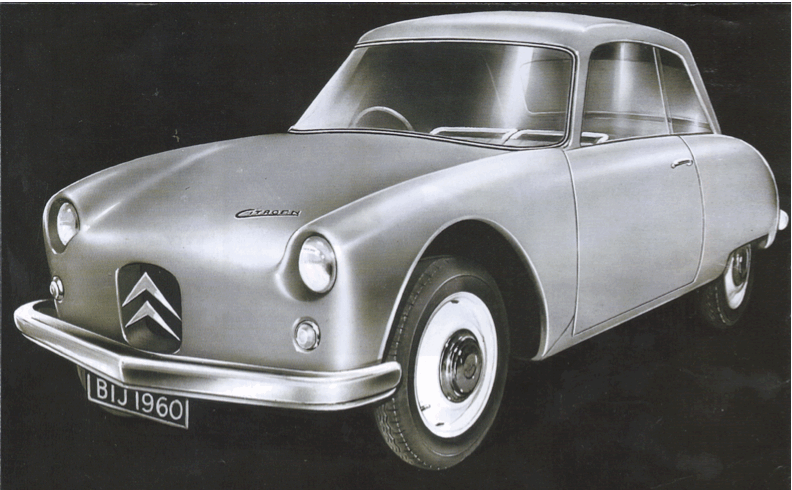
The final version boasted a large rectangular grille with the Citroën name on the hood but without the brand’s dual chevrons logo—signifying it as a Citroën while downplaying its connection to the 2CV.


Convinced of its commercial potential, the English subsidiary of Citroën, far from selling it “under the counter,” decided to roll out the “red carpet” for the Bijou, launching it at the London Motor Show in October 1959. The car, charmingly named “Bijou,” presented to the English public “another idea of the 2CV.”

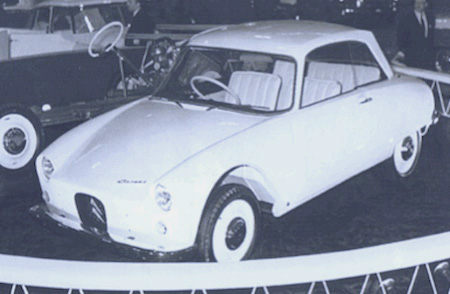
The interior offered a more opulent atmosphere than its French counterpart, featuring a steering wheel and interior door handles borrowed from the DS.


Unfortunately for Citroën England, the various body panels of the Bijou were far from meeting manufacturing quality standards, which forced the workers at the Slough factory to rework numerous components to ensure the cars had the best possible presentation. Additionally, once assembled, the bodies sometimes exhibited a significant lack of rigidity, which contributed to vibrations and unpleasant noises, severely affecting the car’s handling.
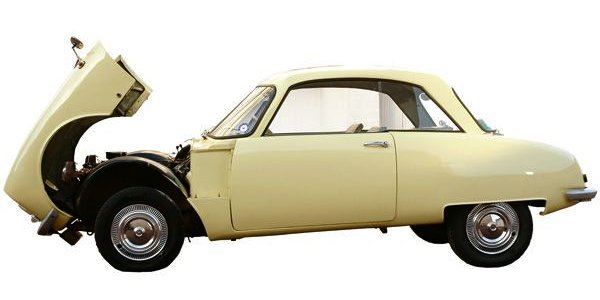
Although the original manufacturer of the Bijou’s bodywork, James Whiston & Co, was replaced by a new supplier, Taylor Plastics Limited, and the body parts provided by the latter were of much better quality, they also weighed significantly more. The evident result was that the 12 horsepower delivered by the 2CV’s twin-cylinder engine struggled to achieve downhill speeds, with the Bijou barely reaching a top speed of 80 km/h—only about 15 km/h more than the original version of the 2CV, which had been marketed ten years earlier. Compounding this was a selling price, reflective of a production process that was still largely artisanal, which remained too high given its performance and average road handling—it was priced at nearly £500, while a more powerful and better-constructed Ford Anglia was selling for barely more at £598.

Quickly realizing that the Bijou had clearly missed its mark and that its failure was evident, the English subsidiary of Citroën decided to halt marketing it as soon as the 2CV platforms from France had all received the new Bijou bodies. This marketing campaign, under the circumstances and considering its lack of customer success, would nonetheless drag on until 1964. In five years, only 211 examples were produced in total, all sold exclusively in the British market; consequently, the 2CV Bijou remained largely unknown to the French public. It is especially unfortunate that Citroën never considered offering it in a left-hand drive version for the French market, as it is likely that the public would have received it far better there than in England.
My friend Roy was an apprentice at Citroën dealer Frank E. Dell Ltd in England when the Bijou was introduced. He and a colleague were out front at the pumps when a Bijou was driven in with a small caravan (travel trailer) attached. The driver told Roy that he and his wife were driving up to Scotland for a touring vacation of the highlands of Scotlands. Knowing that the Scottish border was 350 miles away and the Highlands were much further on, and being very aware of the Bijou’s modest performance, Roy asked, “How many weeks are you going for”?
There is an interesting fun moment which is also famous for this vehicle – when I remember properly, as follows: the very first vehicle was being prepared for the press at one day, and it got the last polish. The person (I do not remember his name) did close the door – and when you did close such doors, at that time, it was not that you would shut them like today: gentle, potentially even automatically retracted – instead he somehow smashed it… and the front window, which was made from the back window of the DS, jumped from its rubber sealing – it had been mounted under too much tension – and fell onto the floor, shattering into 1000s of pieces… not a good start for the presentation…!
I also remember that this car was some 15 years ago for sale on a british backyard, somehow found behind bushes or so, I had offered it to the Conservatoire (I was not the seller, just knew the link) – but there was no interest to buy it: does anyone know whether it was rescued?
I once was about to buy one – it was for sale near Cologne/Germany – but somebody had flooded the doors that massively with gelcoat, to cover the cracks in the panels, that the doors became way too heavy, and the doors would rather hang down too much… and then did not buy it.
There is a full (and boy, they really mean full!) restoration project on ebay now: https://www.ebay.co.uk/itm/168352260326?mkevt=1&mkcid=1&mkrid=710-53481-19255-0&campid=5337315447&toolid=10050&customid=MANUAL&ul_ref=https://rover.ebay.com/rover/1/710-53481-19255-0/1&fbclid=IwY2xjawRoDl5leHRuA2FlbQIxMABicmlkETE3djhOQTY0M2pHbWFtRWZCc3J0YwZhcHBfaWQQMjIyMDM5MTc4ODIwMDg5MgABHupxCc_c-nnINu–2NeAy_aFrvh0wCEHFud0S3Pe6JQHKWWqdeOtf-kKx_wA_aem_givufZvJ1_pyunM8iYYCgA